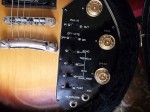
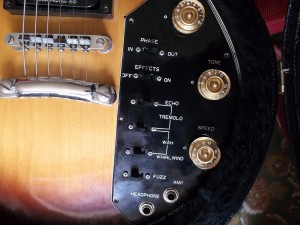
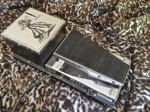
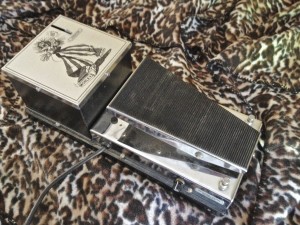
First, he got his hands on a Kay Effector — a psychotronic Korean axe with built-in effects. Then he got it working. Then he recorded a bitchin’ demo. It’s required reading/listening for deviant guitarists.
Has any stompbox ever been as steeped in myth and legend as the Klon Centaur? Doubt it. Original Centaurs are extremely collectible, currently fetching around $1,500 on EBay. But for every player who drools over the prospect of obtaining this rare creature, there’s another who’s foaming at the mouth about idiots who’d pay four figures for a “glorified Tube Screamer.” When you Google “Klon Centaur,” one of the first items to appear is this memorable rant from the always entertaining Zachary of Zachary Guitars:
Here is a guitar pedal which has been around for about 10 years and stands for total Bull Shit in my opinion. The website, the presentation, the marketing, the hype, the price. Everything about it is why I hate the music business and the shockingly stupid guitar consumers. Its a mediocre and common pedal. Its your typical mild Tube Screamer- type of effect and sound. It really does not do much and is not very versatile. I found it stuffy and midrange sounding.In comparison to the great touch sensitivity, clarity, transparency and the wonderful independent Clean Boost section of the Zachary Pedal, well…there is absolutely no comparison.
Yow.
For a bit of perspective, how about we just listen to the thing? Here a little video demo, followed by a few observations.
Is it just me, or do many guitarists these days find themselves alternating between separate analog and digital setups?
I’m posting some pics of my current pedalboards (bearing in mind that, for reasons I’ll get into in a sec, my pedalboards only tend to stay “current” for a few days at a time). Both were assembled using store-bought housings, though I’ll talk a bit about total DIY boards as well.
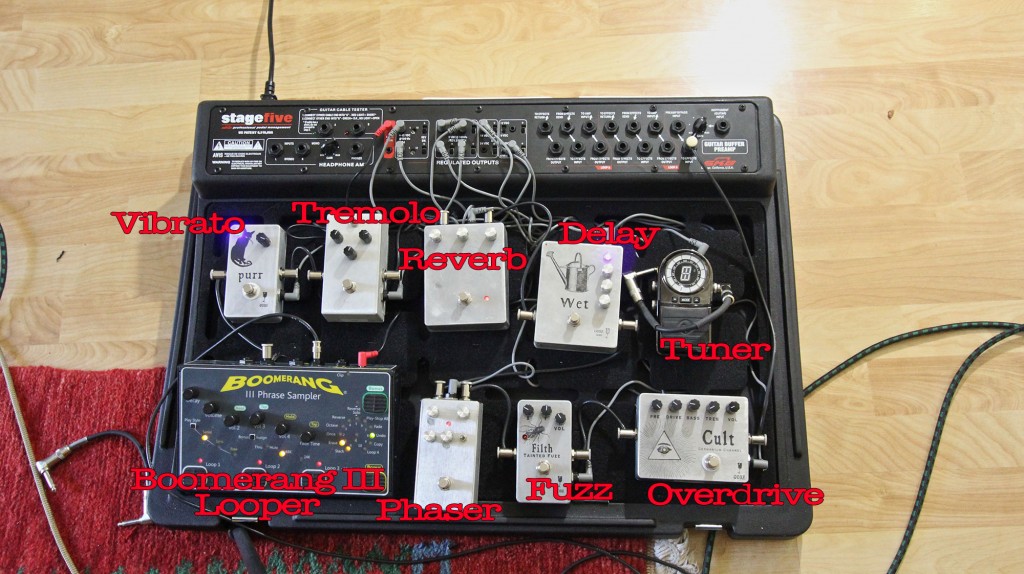
First, the mostly analog setup (the exception, of course, is the digital Boomerang III looper).
Joe Gore’s mostly analog pedalboard.
The case is a newly purchased SKB Stage Five, a full-featured unit in a relatively rugged molded plastic case. These retail for a whopping $540, but you can find them heavily discounted. (I forget the exact price I paid for mine, but it was under $300.) It’s loaded with cool features, like dual effect loops, a built-in buffered preamp, and support for 9- through 24-volt DC power, plus 9V AC for those digital pedals like Line 6 modelers and many loopers. There are even trim pots on a few power jacks to simulate dying batteries. I’m less impressed by some of the fittings (like the cheapo plastic jacks), though I suppose they keep the weight down. And make no mistake: This thing is heavy!
Verdict: Too early to tell, since I haven’t subjected it to road abuse, but I trust it enough to at least give it a go. I think I’d be a bit disappointed had I paid full pop, but it strikes me as a fair deal if you can find it at a 40+% discount.
Two indisputable facts about Leslie rotating speaker cabinets: They sound awesome, and they’re approximately the size and weight of Rhode Island. Since the ’60s manufacturers have attempted to mimic the spinning-speaker effect in a more modest package. And one of the best mimics is the second exhibit in our Museum of Lost Effects.
The Morley Rotating Sound Wah is less well known than an earlier pseudo-Leslie, the Univox Uni-Vibe,forever associated with Hendrix. Like the Uni-Vibe, it a) tried to duplicate the Leslie, b) failed, but c) wound up creating a cool tone of its own. But while the Uni-Vibe milks its modulation from a series of optical sensors, the Morley relies on a rotating disc inside a can of electrostatic fluid. The result is a cool and complex modulation sound unlike any other (and one I’ve never been terribly successful at mimicking digitally).
This technology is descended from the “oil can” delays produced in the ’60s by the Los Angeles-based Tel-Ray company.In fact, Morley was a Tel-Ray spinoff — company founders Ray and Marv Lubow chose the name Morley for their line of guitar pedals based on the boast that this relatively compact modulation effect offered “more-lie,” as opposed to “less-lie.” (Note that I said “relatively” compact, since this beast is far and away the heaviest stompbox I’ve ever owned.)
The Morley Rotating Sound Wah is ugly, clunky, and klugey. If you drop it on your foot, you’ll never walk again. But I think it sounds incredibly cool.
Well, I’m not sure it’s fair to call it a “museum” when there’s only one exhibit so far. But it’s a really, really good one…
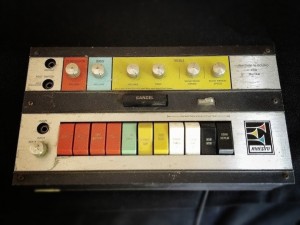
I bought this Maestro Rhythm ’N Sound for Guitar for a pittance back in the ’90s. It’s a primitive multi-effect unit from 1968, with a cool octave-down bass tone, auto-wah, and two fixed filters. It’s got fuzztone (though mine has always been broken), and a weird, choppy tremolo reminiscent of the Vox Repeat Percussion effect. (Mine worked fine — until I broke it yesterday while trying and failing to fix the fuzz. Kill me now.)
But the marquee feature of this hand-soldered contraption is the option of triggering four wonderfully cheesy analog percussion sounds. Bongo? Cymbal? Tambourine? Clave? At your command!
Does it sound as weird as it sounds? No — weirder!
You can’t assign specific specific notes to specific sounds — any input triggers the percussion, so the clicks and clanks tend to work best shadowing every note in a phrase, adding a weird edge. (I used them like that on Oranj Symphonette’s “Charade,” Erica Garcia’s “Yo No Tengo La Culpa,” and PJ Harvey’s “Maniac.”)
But then it occurred to me you could more ambitious things with the percussion sounds via looping. Which is exactly what I do in this short, fuzz-free video.
Check it out — and then let’s talk about this Museum of Lost Effects thing!
Does music groove more when all the effects are sync? Tough question!
Does music groove more when all the effects are in sync?
What’s better: synchronizing your modulation and delay effects strictly to tempo? Or “freewheeling” it, and letting the effects wobble and drift a bit?
I eagerly embraced tap-tempo stompboxes when they appeared — how liberating to re-clock your effects without stooping over and fumbling with little knobs! But these days, I often forego strict timekeeping in favor of a sloshier, more organic feel.
Sometimes tempo-sync makes parts groove better. And sometime it makes everything sound cheesy, like the computer-clocked sound and lights of a loud and lousy Broadway show.
One thing that made me more reluctant to over-synchronize my sound was the illicit release of the various “Multitrack Master” audio files, in which classic rock recordings were distributed as individual solo tracks — an illegal yet awesome development I wrote about here. This example in particular blew my mind:
Okay, the analog delay effect on that iconic keyboard part is a bloody mess, the echoes flamming chaotically against the played notes. But would anyone dare suggest it’s not one of the grooviest parts ever committed to tape?
On the other hand, when I do go digital, I’m more likely to take it to extremes. Here’s a little example I threw together using a multi-effect plug-in created with Native Instruments’ Reaktor. (Reaktor itself isn’t an effector, a synth, or a sequencer, but a programming environment for creating all those things and more. This plug-in, called Freak Show, is free for Reaktor owners via the Reaktor User Library. The creator is Carsten Brück.) It’s a set of eight effects — but the active effect changes in time with the sequencer. (You might have reverb on beat 1, pitch-shift on beat 2, phasing on beat 3, etc.) Check it out:
These funky homemade pedals represent all the leading octave-fuzz circuits.
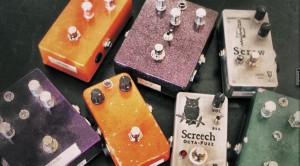
These funky homemade pedals represent all the leading octave-fuzz circuits.
I had no idea I had so many octave fuzz pedals! I had no idea they sounded so different! And after spending way too much time auditioning and recording them, I have no idea when I’m ever going to be able to stand listening to them again!
Naw, just kidding — I had lots of fun putting together this octa-fuzz fest. It features no name-brand pedals, just DIY clones based on old circuits. But hey, most of today’s octave fuzzes are also clones of old circuits.
In fact, imitation has always been the name of the game here. The Roger Mayer Octavia used by Jimi Hendrix was inspired by a circuit found in a British mixing console. The US-made Tycobrahe Octavia was a ripoff of Mayer’s circuit, though tone snobs tend to regard it as the superior unit. It’s certainly one of the rarest and most valuable stompboxes ever. The name “Octavia” has also been slapped on many other variations of the circuit, including some particularly dismal models. The Prescription Electronics Experience and Lovetone Ultimate Octave are based on the Foxx Tone Machine. The Dan Armstrong Green Ringer was based on the Ampeg Scrambler, and I used the Green Ringer circuit as a jumping-off point for some of my own designs. The sincerest form of flattery abounds here.
If you make it through this seven-circuit survey, you’ll encounter most of the major players, and if you hear something that particularly interests you, you can build it yourself using readily available schematics, or buy a nice kit or boutique clone.
Now, don’t confuse this effect with modern digital devices that actually transpose the notes you play. Octave fuzzes use an electronic trick to cancels out much of the fundamental of each note, making the octave overtone stand out more prominently. The process is called full-wave rectification, and ever-knowledgable reader mwseniff explains it far more capably than I in a comment following my previous post on this topic. It’s an odd, glitchy effect that tends to require specific playing techniques for the best results. And for better or worse, it’s an effect that has so far been difficult to mimic digitally. Sure, some of the modeling boxes out there have interesting-sounding octave-fuzz effects, but they tend to score low on the analog-realism scale.
Check out the video. The post-mortem comes after, as post-mortems usually do.
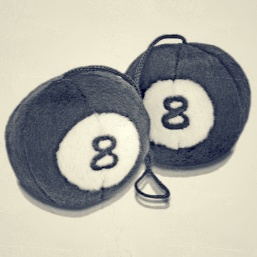
Eight as in octave. Fuzzy as in fuzz. Get it? Oh, never mind.
They’re fuzzy eight balls, okay? Eight as in octave. Fuzzy as in fuzz. Get it? GET IT? Oh, never mind.
Anyone have any strong feelings about octave fuzz? I’m guessing so, because not many effects produce stronger feelings. It’s not a path for the faint-hearted. Or control freaks. Or frankly, most guitar players.
I rounded up all my octave fuzz pedals and made an amazing discovery: I have way too many of them! I’m putting together a video demo of some faves, and will post it in a couple of days. But I couldn’t wait to start talking about it this quirkiest of effects.
One cool thing about going indie with tonefiend is that fact that I can finally host my own geek forum! It’s already up and running — but it’s a sad, vacant space that desperately needs to be populated by cool people and cool ideas.
How to get there? Sleazy bribes! Cool prizes!
Here’s the deal: I’ve pre-populated the forum with a few topics and threads. Just come on over, register, and chime in on any thread that interests you — or better yet, start one of your own. And on September 1st, 2012, the three forum members who have consistently contributed the liveliest content as judged by some dork me will get a bitchin’ stompbox laboriously hand-built by the same dork me. I can’t disclose exactly what the pedals will do, but I can promise they will be cool, useful, and genuinely unique — original designs, not some lame-ass Screamer clones. And if I manage not to vaporize my hand with the TechShop laser-cutter I’ve been learning to use, they’ll even have wicked laser-etched enclosures.
Naturally, I hope the tonefiend forum will also be cool and unique, and that you’ll enjoy geeking out there even when there’s no contest. But hey, I’m not above greasing the skids with free stompboxes as needed.
Last winter I tried an odd experiment: a website where players were encouraged to post their best tone secrets — the kinds of tricks and techniques that are almost too good to share. But in order to get, you had to give: The site was password-protected, and the password was only sent to those who contributed secrets.
Musicians responded, no doubt encouraged by the cool prizes awarded to the top secrets, as judged by user ratings. I also asked some cool musician friends to contribute the first round of secrets, yielding tips from the likes of composer/virtuoso Lyle Workman, metallurgist-turned jazzbo Alex Skolnick, original Chili Peppers guitarist Jack Sherman, boy genius Blake Mills, and other great players.
Once the contest ended, traffic slowed, but the site has slowly but surely grown. And now, as an experiment, I’ve removed the password protection. Now anyone can visit the Secret Room, AKA tonesecret.com, even if they haven’t coughed up a secret. So please do!
It’s a fascinating document. Naturally, the quality of secrets varies, as does the level of expertise needed to make the most of them. I exerted a light editorial hand — only silly or flat-out-wrong tips were vetoed, and I didn’t do much in the way of spelling and grammar repair. Sometimes the contents are a little repetitious — but trust me, there is much wisdom and originality throughout.
I hope you find something helpful — and I hope you’re moved to contribute some secrets yourself using the site’s submission form. And who knows? There may be more tawdry bribes fabulous prizes lurking around the corner…