Categories
Music

James Horner, 1953-2015

James Horner, one of the most successful film composers in Hollywood history, died yesterday after crashing his single-engine plane near Santa Barbara, California. He was 61.

It’s hard to pinpoint the highlight of Horner’s career — he scored such mega-hits as Titanic, A Beautiful Mind, Avatar, Braveheart, and many other films. But I can definitely point to a career lowlight: tutoring a struggling 16-year-old freshman music student in a musty, claustrophobic practice room at UCLA’s Schoenberg Hall in 1975.
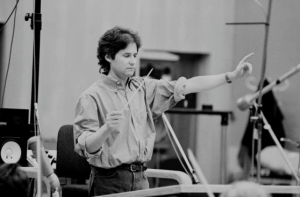
Seen here conducting his Braveheart score, Horner looks just as I remember him from 1975.
Seen here conducting his Braveheart score, Horner looks exactly as I remember him from 1975.

The tin-eared student was me — an incoming music major inadequately prepared for the rigors of college-level theory and musicianship. The TA leading my two-hours-per-day core class suggested I hire a private tutor to save me from sinking, and he recommended his fellow grad student, “Jamie” Horner. Borrowing a little extra cash from my folks, I paid Jamie some meager hourly fee ($10? $15, maybe?) to subject me to ear-training boot camp. It was basic music-major stuff: dictation (notating melodies and eventually counterpoint by ear alone), score-reading, sight-reading, sight-singing, and the like. (I needed the help! Then, as now, I was no “natural” musician. I labored mightily to acquire such skills.)

Jamie (as everyone called him then) was perfectly nice, but we weren’t pals or anything — he was just a busy and ambitious grad student earning a few quick, if measly, bucks via boilerplate tutoring of a slow student. He’s already embarked on his film scoring career, and his example was one of my earliest and most powerful eye-openers about the brutality of the biz.

Jamie was ridiculously gifted. He had laser-like focus on his goals. He was hereditary Hollywood royalty. (His dad was Harry Horner, an Austro-Hungarian émigré and famed production designer, and I think Jamie grew up with people like Otto Preminger as dinner guests.) And he was still ghost-writing scores for dog-shit films for next to nothing. For some, Jamie’s steep uphill path would have been an inspiration. But it scared me the hell away from his profession. (And today’s Hollywood scoring scene is vastly more brutal than it was back in the ’70s.)

I attended school during the last gasp of modernism. The focus was avant-garde 20th-century music, from Arnold Schoenberg to such then-leading lights as Luciano Berio, György Ligeti, and Witold Lutosławski. (You know — the ear-hurtin’ atonality that only perverts and music professors love.) Post-Romantic music was considered hopelessly tacky. No one studied Richard Strauss, especially his later, reactionary stuff! But I remember Jamie walking around with Strauss’s Alpine Symphony score under his arm. He was smarter than everyone else.

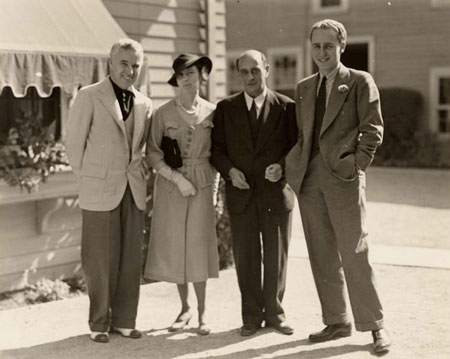
My favorite memory: A few years later in school, after I’d caught up and was doing okay, I had the unforgettable experience of taking a few semesters of David Raksin‘s film scoring class in the UCLA film department. Raksin was an amazing figure who worked with some of Hollywood’s greatest talents. (This photo sums up his significance. It’s Raksin on the right, posing with his teacher, frickin’ Arnold Schoenberg himself, Mrs. Schoenberg, and the man who gave David his first big break: Charlie Chaplin.)

Jamie dropped by Raksin’s class to meet David for a lunch date at the faculty restaurant. David kindly asked me along. (He’d taken a shine to me, not for any music skills, but because he liked what I’d written about scoring in my term papers.) So I got to tag along and listen to two geniuses talk shop. I just sat there trying not to say anything too stupid. I doubt I succeeded, but I’m grateful all these years later to have basked in their collective brilliance for a few minutes.

And I’m grateful to James Horner for helping me along. My heartfelt condolences to his family, friends, and colleagues.
Categories
Digital guitar Music Technique

Less-Boring Looping (“Pumped-Up Kicks” Cover)

For a while I’ve been playing this loop-based cover of Foster the People’s “Pumped-Up Kicks” at solo gigs and with my duo band, Mental 99. At risk of sounding like a pompous dick, I’ve annotated the performance, highlighting techniques I’ve found useful for making loop-based performances livelier and less predictable.

I’ve covered some of this ground before, particularly in this Premier Guitar looping-technique article. But here I call out the techniques mid-performance, and I’ve included a few new ones. I hope you find some of them useful.

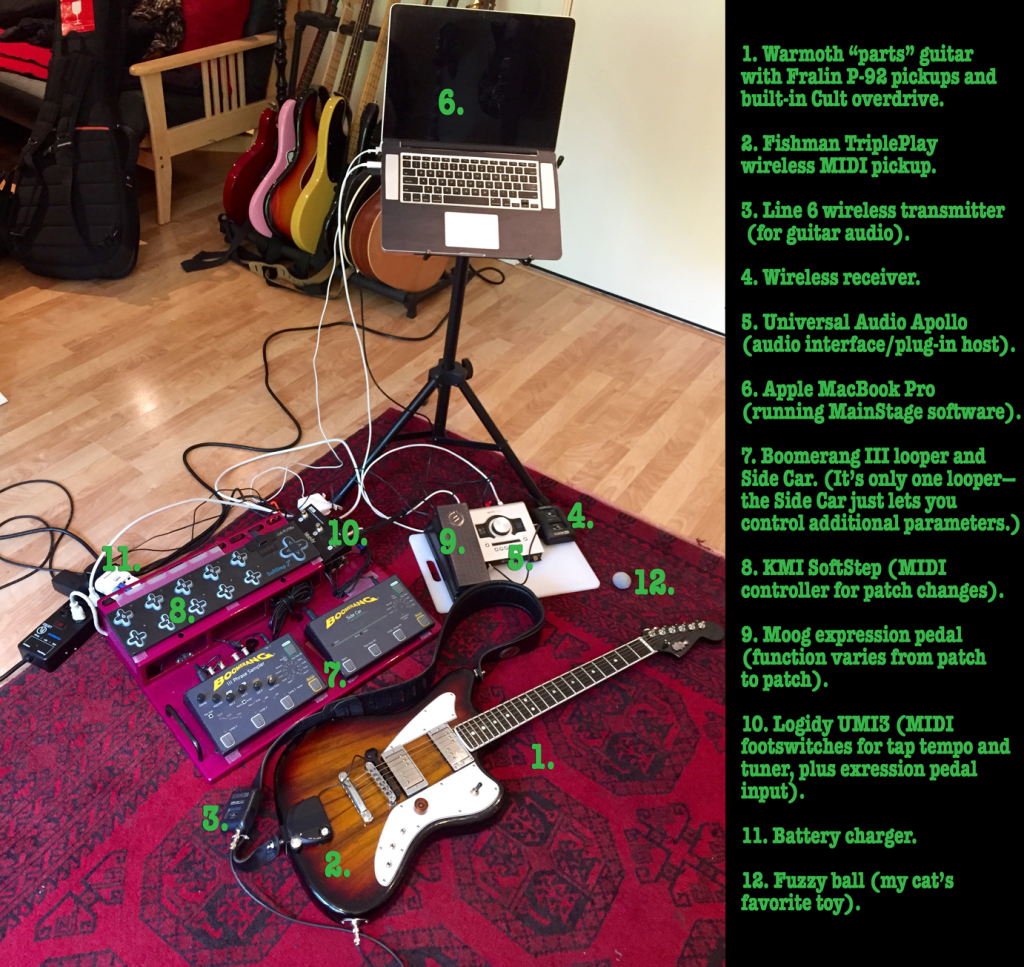
Likewise, I’ve already written about my live looping rig, but it’s changed a bit since then, and I’ve recently integrated a Universal Audio Apollo Twin interface (plus the stellar plug-ins it allows me to run). An updated overview:

Pedalboard-Diagram

The arrangement perform nicely, and I dig the individual components. But I dislike the system’s Rube Goldberg complexity—it’s a royal pain to set up and schlep. I’m always looking for ways to simply. (Other than, you know, just plugging the guitar into a frickin’ amp.) I’m open to suggestions for streamlining!

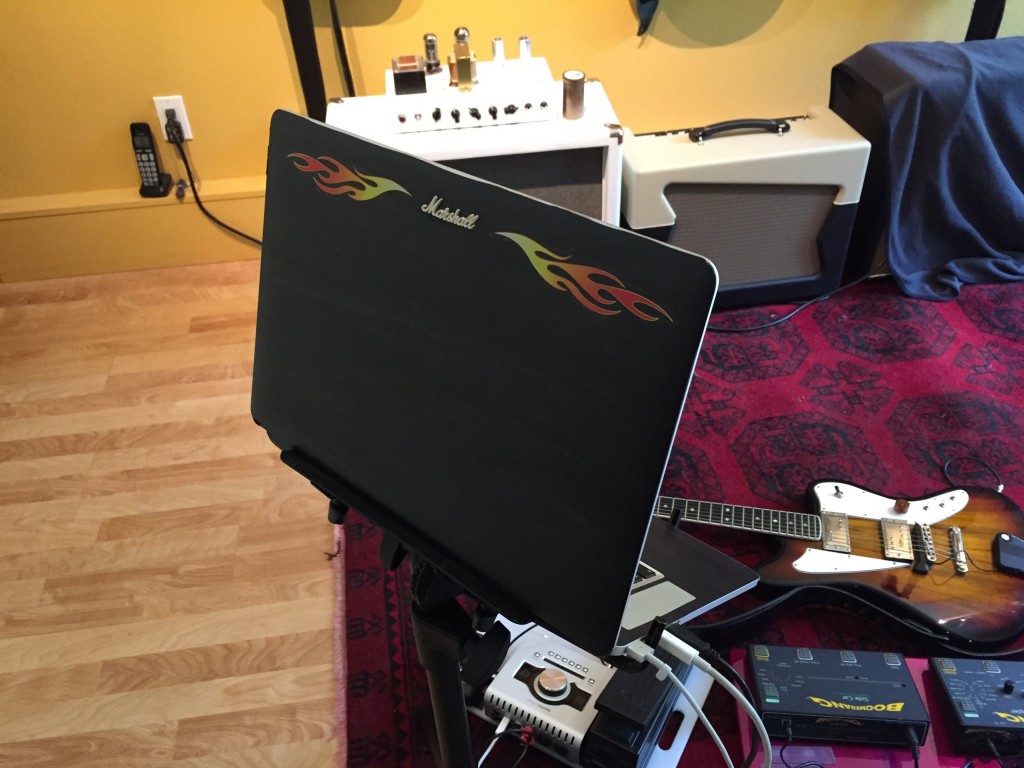
Black Mac
I love Apple products, but I hate having Macs onstage (mainly ’cause they’re so much better looking than me). Covering it in black wrap makes it less obtrusive. The Marshall logo is from one of those “toy” stacks (which, of course, can be far more than toys in the studio).
Categories
guitar

Those $24 Acoustic Strings

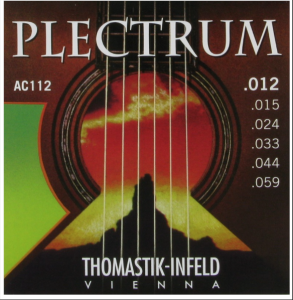
As if I weren’t already blowing enough money on arcane strings, I’ve got a new obsession: Thomastik-Infeld Plectrum series acoustic strings (which sell for $24 in the U.S.).

If you hang out here much, you’ve heard me bitch incessantly about acoustic strings. I hate the way most modern strings are all hyped treble zing and blaring volume, at the expense of deep, decisive fundamentals. With due respect to my vegetarian friends, too many strings are all sizzle and no steak.

Screenshot 2015-06-03 14.55.56

Yeah, bright strings can seem energizing in a cocaine-binge sort of way. But all that glassy presence gets fatiguing. Meanwhile, darker bass strings leave sonic space for the treble strings to shine. Even on my teensy-tiny Martin 0-17, these low strings sing in a warm baritone voice, not like some squeaky, poorly Auto-Tuned teen idol.

This pricy Austrian set features brass-coated steel 1st and 2nd strings, while the bass strings are bronze, but with both silk inlays and flexible steel cores. The flatwound 3rd, 4th, and 5th strings nix finger noise and minimize tone contrasts between wound and unwound strings. The polished roundwound 6th string adds a touch of focus to the lowest register, yet introduces no awkward contrasts on melodies played across multiple strings.

The set is low in both tension and volume relative to most U.S.-made strings. Even though the low E is a chunky .059, it has a soft, relaxed feel that makes me want to linger over notes, shaping them. The harmonic range is fantastic, the dynamic range even more so. They’re long-lasting too — this video was recorded three weeks and many playing hours after installing the set.

I’m hooked. Damn it.

(Hey, Mr. Tambourine Man — I don’t want you getting your nasty treble overtones all over my acoustic strings, no matter how frickin’ jingle-jangle the morning happens to be. Just back off, pendejo.)

Categories
Gigs

Solo Guitar Shows: L.A. Confidential & Furtive Frisco

LA_kitty

Psst…this week I embark on a grueling two-city solo guitar tour.

I’m playing my first ever L.A. solo show next Tuesday, the 12th, with one of my favorite players on the planet: the brilliant Mark Goldenberg. I’d previously know his pop work, but only became aware of his amazing solo playing last year when we both performed at one of Teja Gerken‘s guitar events. It was love at first note. We bonded on our affections for Ellington and ’60s L.A. pop, and the fact that we were both Ted Greene students. Plus, he’s just a cool guy.

The show’s at Genghis Cohen (740 N. Fairfax near Melrose). Danielle D’Andrea plays at 8:00 PM, Mark’s on at 9:30, and and I play a bit after 10:00. Maybe Mark and I will even work up a duet or two.

Admission is 10 bucks. The show is all-ages. If you’re in SoCal and free on the 12th, please join us!

My pal Bill Selby drew this amazing illustration. I'm going to hell for defacing it in Photoshop.
My pal Bill Selby drew this amazing illustration. I’m going to hell for defacing it in Photoshop.

And then, on Thursday, the 14th, I play my monthly solo show at my beloved local dive, San Francisco’s El Rio. This one’s special too: My guest star is another astonishing player, Giacomo Fiore. Giacomo is rightly renowned as one of of our greatest avant-garde classical guitarists, specializing in difficult modern repertoire. But this time, Giacomo’s performing an all-electric set. I have no idea what to expect, though I’m certain it will be astonishing. (In addition to releasing some remarkable recordings, Giacomo lectures at several noted Northern California universities and conservatories, and he gets excellent marks on Rate My Professor. Just sayin’.)

This show is free, but over-21 only. I play at 7PM sharp, and Giacomo starts around 8.

Remember, you heard it here first — off the record, on the QT, and strictly hush-hush.*

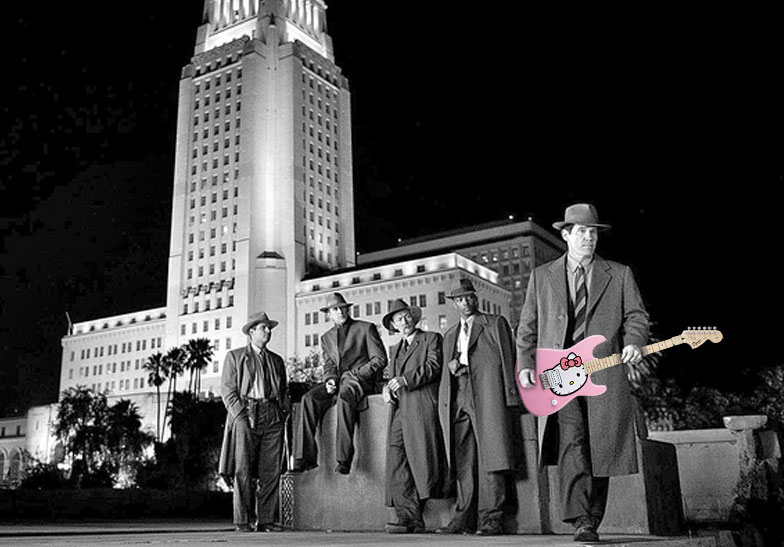
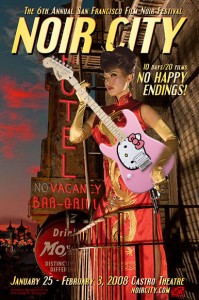
* This quote, the post title, and the noir pics are inspired by James Ellroy’s L.A. Quartet, probably the greatest series of hardcore crime novels ever. (And Ellroy’s newly released prequel, Perfidia, is every bit is awesome.)

Categories
Effects

Heaviest. Stompbox. Ever.

I’ve been breathlessly awaiting one of these since I saw this. It’s Korg’s Miku Stomp, a spinoff from the company’s Vocaloid voice synthesizer. It tracks your pitch as you play and responds with a synthetic voice that forms various syllables and phrases.

There’s some cheating here: The effect’s latency is quite severe, so I had to slide the Miku track back in time while mixing. Its triggering is also inconsistent, so I replaced a few notes. Miku tracks best when playing melodies on a single string, hence my awkward, position-jumping fingering. (Actually, it tracks pretty well when you play slow melodies full of sustained notes. But steady eighth-notes at 155 BPM as heard here is a major challenge.)

One of the pedal’s most interesting aspects is the way it interprets slurs. When there’s no break between notes, Miku sings a sort of pseudo diphthong. Detached notes get a syllable with a clear transient.

IMHO, the inescapable facts that Miku is silly and doesn’t work terribly well doesn’t diminish her total awesomeness. No doubt about it: heaviest stompbox ever.

The tune, of course, is “Georgy Girl,” which I’ve loved since forever. It was a blast recording the backing tracks with classical guitar, ukulele, ukulele bass, 12-string, toy piano, M-Tron Pro, and a mix of live and sampled percussion. And of course, gobs of my favorite reverb effect: Universal Audio’s EMT140 plate simulation. Yum.

Categories
Recording

In Search of Ancient Ambience

Screenshot 2015-03-31 10.29.54

Premier Guitar just posted my latest Recording Guitarist column. The subject: Capturing the haunting reverbs of Southwestern ruins via impulse-response reverbs.

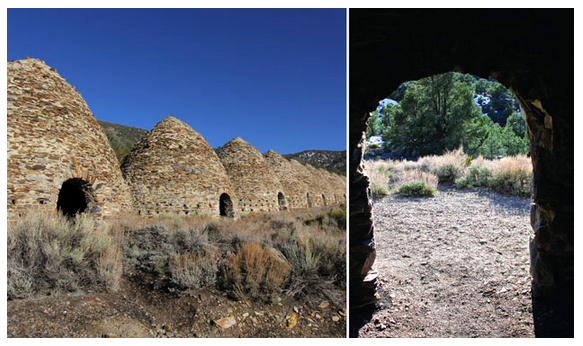
Many years ago I marveled at the eerie reflections within the stone-walled ball court at Wupatki, an hour north of Flagstaff, Arizona. On this visit, I attempted to clone the tone. I did the same at the Wildrose charcoal kilns in a remote, mountainous corner of Death Valley. The article includes audio clips, tech notes, and a download link for the impulse responses, suitable for use in any IR reverb program (or in the Logidy EPSi stompbox).

Screenshot 2015-03-31 10.42.24
The 1870s charcoal kilns of Death Valley generate a spooky,, flange-like reverb.

Like a dope, I’d forgotten to bring the relatively high-quality recorder I’d intended to use, so I worked with noisy, lo-fi recordings from my iPhone 6’s Voice Memos app. After some digital cleanup (detailed in the article), the results were cool and compelling, though not a completely accurate audio snapshot due to various types of distortion.

(Actually, I had an earlier experience capturing quick-and-dirty reverbs when I visited the Neolithic caves of France and Spain last year. It wasn’t my idea—I just happened to wind up on a tour group with composer Craig Safan, who was conceptualizing a piece inspired by those evocative spaces. He’d packed a proper Zoom mobile recorder, and we made ad hoc impulse responses by clacking small stones together. Craig has since completed the work, Rough Magic, and he tells me his mixing engineer wound up using our IRs a great deal. I’ve heard the piece, and it’s awesome. It’s not public yet, but I’ll tell you when it is.)

Since writing this Premier Guitar piece, I’ve been pondering whether damaged/distorted impulse response files might be an interesting avenue for sonic exploration. Generating cool sounds via weird IRs isn’t a new idea—the Space Designer plug-in in Apple’s Logic Pro includes a little-known IR preset folder titled “Warped,” which uses unusual sources like synth tones and noise bursts to generate reverbs not found in nature. But my interests are reverbs that are both familiar and surreal—the echoes of distorted reality.

And coincidentally, just as I was writing this post, a friend sent this wonderful video: an old Teletubbies clip, processed through a smeary, distorted black-and-white filter and paired with Joy Division’s “Atmosphere.”

I’m pretty much talking about an audio equivalent to that video processing. Has anyone else thought about or explored this idea?

Categories
Acoustic guitar Music

Magic Fairy Dust: The Veillette Avante Gryphon

I recently reviewed the gorgeous little Veillette Avante Gryphon for Premier Guitar and liked it so much that I bought one. This was my first opportunity to record it in my studio.

The Avante Gryphon is a relatively low-cost version of Woodstock luthier Joe Veillette’s Gryphon, an 18.5″-scale 12-string designed to be tuned a minor seventh (an octave minus two frets) above standard. But while 12-string guitars feature octave-tuned string pairs, here all six courses are unisons, as on a mandolin. In fact, the Avante Gryphon sounds a lot like a mandolin, but with a wider range and guitar-like tuning. And unlike the couple of janky plywood mandolins I own, it plays gloriously in tune. It’s made (very nicely!) by Korean CNC robots and sells for $1,400, as opposed to $4K+ for Veillette’s hand-built models.

For years I’ve been looking for the right upscale mandolin, but now I’m happy I found this instead. My original motivation was a high-tuned soprano instrument for multi-guitar arrangements, or for magic-fairy-dust studio overdubs. But the thing is so fun — and sounds so darn pretty — that I can’t stop playing it solo. This Bach prelude, for example:

I won’t recap my review here—check it out if you’re curious. Instead, let’s yak about Johann Sebastian!

Categories
Uncategorized

Not About Music: Marvin Gore [1923-2015]

Marvin Gore, 1940
Marvin Gore, 1940

If my blog and video posts have seemed fewer and less fun in recent months, it’s not your imagination. I’ve been shuttling between San Francisco and my childhood home in the LA suburbs, spending as much time as possible with my dad in the wake of a back-to-back broken hip and terminal cancer diagnosis. He passed away on January 28th — my late mother’s birthday.

Dad was many things: an engineer, a thinker, a WWII vet, a rocket scientist, a college dean, a loving husband and father, a passionate progressive, a sci-fi/horror geek, and a world traveler who visited all seven continents.

But there’s one thing he definitely was not: a musician.

Categories
DIY

A New Tone Control Concept — or Is It?

Hey, smart people — let me get your take on this. I’ve been playing with a new tone control idea that’s so simple, I can’t believe no one’s done it before. (Chances are someone has.)

Here’s the idea: Conventional electric guitar tone controls employ a single pot and single capacitor connected to ground. As you turn the pot, more signal goes to ground for a darker sound. The capacitor value determines the cutoff frequency — the larger the cap, the lower the cutoff frequency and the darker the sound. In other words, the cutoff frequency is fixed, but the percentage of signal that gets cut off changes as you move the pot.

Meanwhile, the Gibson Vari-Tone circuit uses a rotary switch rather than a pot, and a set of capacitors of ascending size. The small caps have a brighter tone, and the large ones sound darker. But once a cap is engaged, it’s engaged all the way. In other words, the cutoff frequency varies as you move the switch, but not the percentage of affected signal—it’s always 100%.  (The Stellartone ToneStyler employs the same concept, with as many as 16 caps arranged around a rotary switch.)

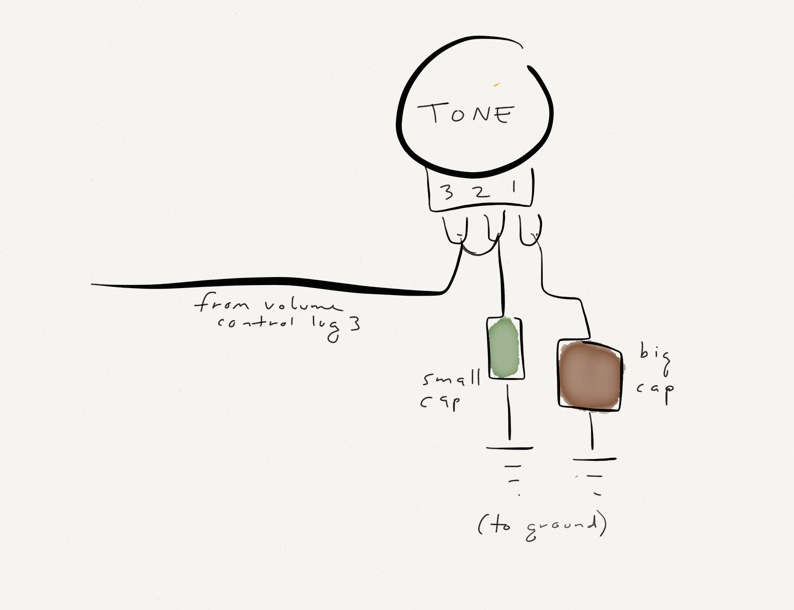
But do you really need all those caps? Why not use the tone pot to fade between a small cap and a large one, like so:

double cap

Here, the brighter/lower-value cap is engaged when the pot’s all the way up. As you roll it back, the larger cap is introduced, producing greater capacitance and a deeper treble cut. When you arrange caps in parallel, their total capacitance is the sum of their values. For example, I tried a .0047µF cap and a .047µF, so the minimum value is .0047µF (a very modest cut) and the maximum is approximately .052µF (a very dark tone).

So far I’ve only tried this on breadboard, though I plan to deploy it in a new “parts” guitar I’m assembling. So far it sounds … really good. A lot like a ToneStyler, actually, but with fewer parts and handpicked values. The only tricky thing was finding a good pot value where all the action wasn’t bunched up at one end of the knob’s range. A reverse-log pot worked best for me—I got nice results with both a C500K and C1M.

I often use similar wiring to alter the value of the input cap on distortion pedals. (High values filter our more bass for a brighter/cleaner sound.) But I’m not aware of anyone having tried this on a guitar tone control.

Another issue is the fact that, in this circuit, the tone pot always has a cap engaged. You could use a really tiny value for the smaller cap so there’s little perceptible cut at the minimum setting, but that can make a substantial part of the pot’s range a little too subtle. So my plan is to combine this with a Ned Steinberger-designed JackPot as the volume control. This part has an “off” setting that bypasses the tone circuit entirely for a maximum-bright sound. That way, I’d choose for the smaller cap a value that provides the minimum treble cut I’m likely to want. (I suspect I’ll wind up with something between .0022µF and .0047µF.)

Have any of you seen or heard of such a guitar circuit? If so, any observations or advice?


Categories
Uncategorized

Frets in Flight, 2015

Here are the new U.S. Department of Transportation rules on flying with musical instruments. Sounds like carriers are required to check instruments.

The key passage, per the DOT site:

The rule requires that each U.S. carrier subject to this regulation allow a passenger to carry into the cabin and stow a small musical instrument, such as a violin or a guitar, in a suitable baggage compartment, such as the overhead bin or a closet, or under the seats, in accordance with FAA safety regulations and the carrier’s FAA-approved carry-on baggage program.

Carriers must allow passengers to stow their small musical instruments in an approved stowage area in the cabin if at the time the passenger boards the aircraft such stowage space is available. Under the rule, musical instruments as carry-on items are treated no differently from other carry-on items and the stowage space should be made available for all carry-on items on a “first come, first served” basis. Carriers are not required to give musical instruments priority over other carry-on baggage, therefore passengers traveling with musical instruments may want to buy the pre-boarding option offered by many carriers to ensure that space will be available for them to safely stow their instruments in the cabin.

Maybe we should do like my pal Shelley Doty recommends and carry a copy of this every time we check in for a flight.

kitty_plane