This is a companion piece to yesterday’s version of John Barry’s Midnight Cowboy theme. It’s the main title from Jerry Goldsmith’s score for In Like Flint, a kitschy Bond parody that predated Austin Powers by decades. I was too young to see the film as a kid, but a radio ad featuring this theme blew my impressionable mind. I seriously believe the theme’s #4s and b2s triggered my lifelong love of dark chromaticism.
I’ve covered this once or twice before, though the sounds are quite different here.
The guitar is an unremarkable 1982 Les Paul Custom — the cheapest real Paul I could find when I needed one for an Apple sound design project. It’s even stamped “SECOND” on the back of the headstock. But the only original parts are the neck and body. The pickups are unpotted Duncan Seth Lover PDFs, and the guitar houses the most ridiculously over-the-top wiring scheme I’ve ever attempted.
I’ve been following the story of Fishman Fluence pickups and their radical pickup design for a few years. From the beginning, I’ve thought Fluence pickups sounded great in the hands of some other guitarist, but this is the first chance I’ve had to experiment with my own set.
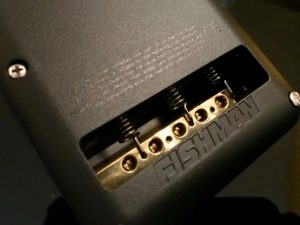
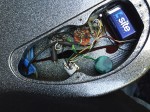
Most of the tech details are in the video. But in brief: These are active pickups with magnets, but no wire coils. Instead, the “coils” are printed on thin pieces of circuit board glued together like plywood. This design removes all noise and hum — chances are these are the quietest single-coil-sounding you’ll find. (Fishman also makes humbuckers and Tele pickups.) They can run on 9-volt batteries or (this is the other interesting part) a separately sold battery pack that replaces the trem cavity back plate. (There are other battery configurations for other guitars.) Another marquee feature: Each Fluence set includes a push/pull pot to switch between vintage voicing and a hotter “modern” sound.
This technology originated at an aerospace company. Someone there realized that their printed coils might work on musical instruments, and they contacted a leading pickup manufacture, who passed on the idea. Next it went to Larry Fishman, who was all over it from the get-go. He refined the idea and came up with lots of clever engineering to make it work in guitars. [DISCLAIMER: I have been paid in the past as a freelance contributor to Fishman products, but no one paid me to post this.]
To my ear these sound perfectly authentic, though the fact that they’re active is problematic for me personally. (That’s because I use so many retro stompboxes that don’t play well with the active pickups, which are buffered. The same goes for most of the pedals I sell.)
Killer, indeed!
While installing this in my much-abused MIM Strat, I also added a heavyweight bridge, trem block, and claw from Killer Guitar Components. I’m not kidding when I say “heavyweight” — it’s a formidable piece of metal, beautifully tooled. It feels like a major improvement on the standard design, and I think it sounds great as well (though it’s hard to be definitive about that without side-by-side comparisons). My favorite feature is the way the string inserts are chamfered — strings pop in correctly every time, which. as any Strat player can tell you, it not always the case. Killer, indeed!
I haven’t posted any new video in months and months. It’s not just laziness or business, though I suffer from both. I’ve just been locked away in my studio, trying to create a new live looping system.
I still haven’t nailed it down, so I’m not going to get into a complete run-down yet. But here are the basic ideas.
• I’ve moved from a hardware looper to software looping. When I started this godforsaken looping project years ago, I’d just finished a lot of work on Apple’s then-new MainStage software. At the time, the program’s looper simply wasn’t reliable enough for live performance. Also, my intense signal processing was pushing my MacBook Pro to its limits. But since then, the program has gone through many upgrades. Meanwhile, after years of relative stagnation, Apple finally issued a major MacBook Pro upgrade in 2017. Between the more powerful computer and the refined software, I could finally shift looping and signal processing to the computer. Yeah, there are a couple of disadvantages. For one thing, MainStage’s looper lacks a “copy” function, something I’ve come to rely on a great deal in my arrangements. But it sure is nice not having to run the entire mix through the relatively cheap hardware looper convertors — just the snazzy ones in my Apollo interface. (Of course, now that I’ve transitioned, Electro-Harmonix has just announced a compelling-looking 6-track looper. I’ll have to check that out…)
• I’ve put aside for now the Fishman TriplePlay MIDI pickup. I have no complaints about TriplePlay, which is far and away the best MIDI pickup ever created, and a product I recommend without reservation. But I wanted to be free from the hardware setup. This way, I can plug in any guitar, any time. (I’ve been experimenting with acoustic looping — more on that soon.) I’m still using MIDI sounds, but again, it’s all in software via Jam Origin’s brilliant MIDI Guitar plugin. It works incredibly well without a MIDI pickup, but it’s not nearly as fast as TriplePlay. It’s fine for doubling, or for melodic and textural stuff, but it’s just not speedy enough to play MIDI drums at even moderate tempos. Which bring me to the other big departure …
• I confess: I’m playing to a drum machine. I’m triggering and changing patterns using a KMI !2 Step foot controller. I really wrestled with this decision. I loved the idea of using no machine tempos — it all came from the hands. But at some point I realized that the main reason I was committed to that approach was for bragging rights: “No prerecorded tracks, and no machine rhythms” I could boast. But who cares except geeks like me? Anyway, I still have misgivings about the change, but I’m going with it for now. I think that means, though, that I’ll create more arrangements without percussion, just so I’m not locked to the machine for an entire set.
Meanwhile working with a tempo clock lets me do fun stuff with synchronized effects. I’m especially besotted with Sugar Bytes’s Effectrix, a mind-bending multi-effector that lets you activate and edit effects on a note-by-note basis. You hear it a lot in the “solo” in this video.
I’ve played a few shows with the new setup. The first one was flawed but promising. The second was an unmitigated disaster. Then I doubled up on practicing and (not kidding) started meditating again, which helped a lot. Last time I tried this live, it went really well! We’ll see how it goes at my gig this week.
Anyway, it’s still a work in progress. I’ll keep the curious updated.
I played this cover tune with no irony whatsoever. I love the original.
My friend John Bohlinger from Premier Guitar just shot a Rig Rundown video with one of my utmost guitar heroes, Andy Gill.
I’ve rhapsodized about Gill’s guitar voice more times than I can count. But the aspect of his playing that I love the most is the way he created such a definitive voice with zero reference to prior rock and blues. If I’d ever worked at Art Forum like my wife did, I could probably draw comparisons to Luigi Russolo’s futurism and Jean Dubuffet’s art brut, but really, I just dig Gill’s blunt, brutal badass-ness.
The big surprise for me in this interview: These days Gill plays through a laptop running Logic, and he’s using some of the stuff that I helped make while sound-designing guitar components for Apple. This news makes my year (though given the year we’ve all been through, walking to the corner store without breaking my ankle would probably also make my year).
Nice work, JB! And thanks, Andy, for the endless inspiration since 1979’s Entertainment!
I’ve been nursing the idea of arranging this most exquisite of Brian Wilson songs for multiple guitars for a long time. But two recent developments spurred me to finally do it.
Spirit of ’67 The first was my plan to record my first-ever solo album — a collection of heavily reinterpreted songs from 1967, tentatively titled Sixty-Seven Ghosts, marking the 50th anniversary of that memorable musical year. I was eight years old then, too young to play the music, but old enough that the music’s “ghosts crowded the young child’s fragile eggshell mind.” (I quote Jim Morrison, one of many crucial artists who debuted in that year.)
When I started playing music seriously a few years later, I had a sense that I’d missed the party, and that the music of ’67 was simply more meaningful than my early-’70s middle-school soundtrack. (I was wrong, of course. Subsequent decades have proven that if anything, the first years of the new decade produced at least as much great stuff. Yet 1967 had a mythic aura for me, and much of that year’s music has pursued me for a half-century.)
I wasn’t hip to “Surf’s Up” till those middle-school years, when the Beach Boys belatedly included the track on their 1971 album of the same title. The FM radio hits from that disc were “Long Promised Road” and “Feel Flows” — “Surf’s Up” was simply the record’s quirky coda. A few years later I discovered “Surf’s Up” lyricist Van Dyke Parks’ solo albums, with their similarly surreal lyrics and left-field song structures.
The Smile Mythos But I had no inkling of the song’s true provenance till some 20 years later, when pop fans began to grow obsessed with Pet Sounds and its “follow-up that never was,” Smile. Only then did I learn that “Surf’s Up” was originally from ’67, the intended centerpiece for that literally legendary album. By then we all knew the Brain Wilson crackup story, with its echoes of Greek tragedy. He’d held the music of the gods in the palm of his hand — so legend had it — only to have it ripped away by demons of self-doubt. Madness and self-destruction ensued.
My personal Smile mythology was heavily influenced by Lewis Shiner’s 1993 novel Glimpses (which I wrote about here). In it, a modern music fan realizes he can go back in time to the moments when great musical masterpieces were lost. (Sounds silly, but trust me — it’s not.) The highlight for me was the Wilson sequence, where our protagonist meets Brian at his peak moment of genius and fragility, right before everything went off the rails. The scene where Brian played the brilliant new songs for his hater bandmates haunted me: (more…)
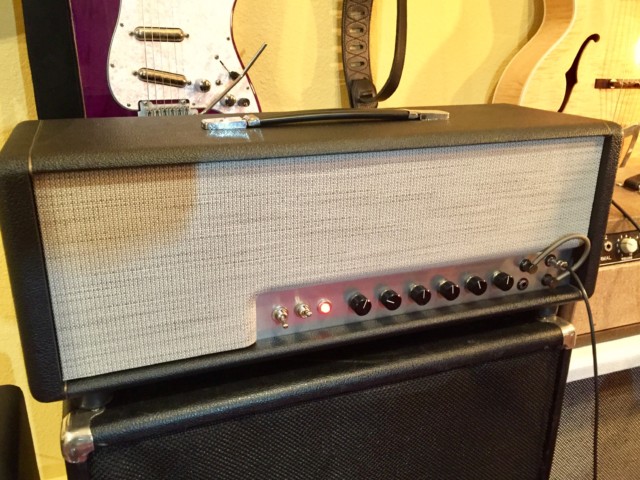
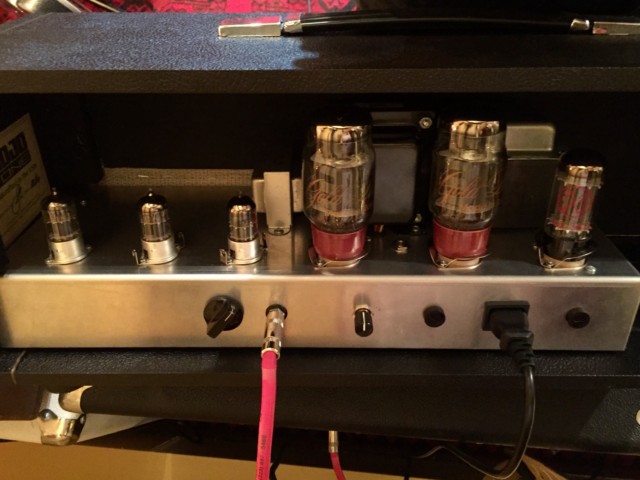
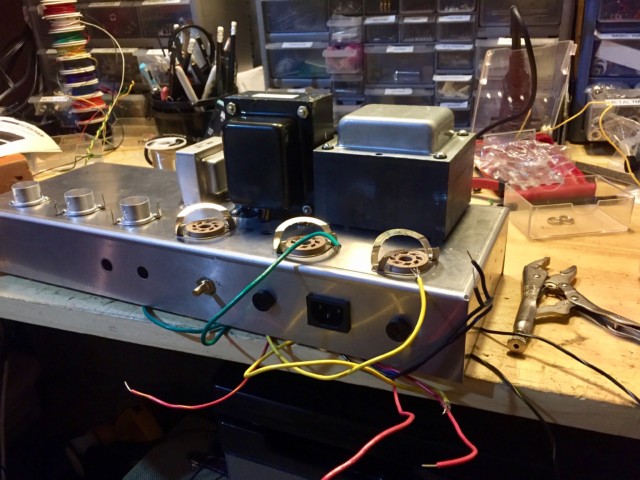
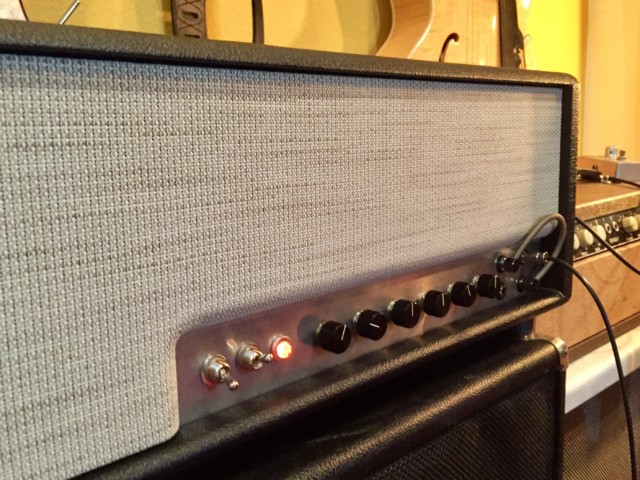
I almost always play small combo amps of 20 watts or less. But I wanted something with a bit more clean headroom for a possible upcoming project — and to demo my stompboxes. I’ve always enjoyed playing JTM-45s when I’ve reviewed them for guitar mags, so I ordered Monotone’s British 45 kit.
I’d previously had a great experience building Mojotone’s Marshall 18 watt clone kit when I reviewed it for Premier Guitar a couple of years ago. It turned out great, and I use it regularly.
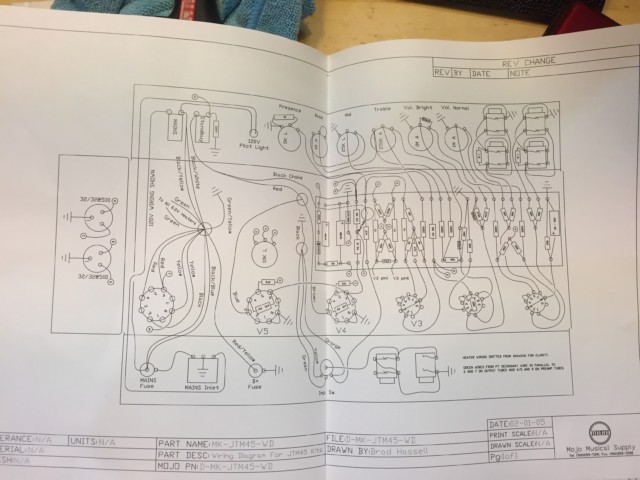
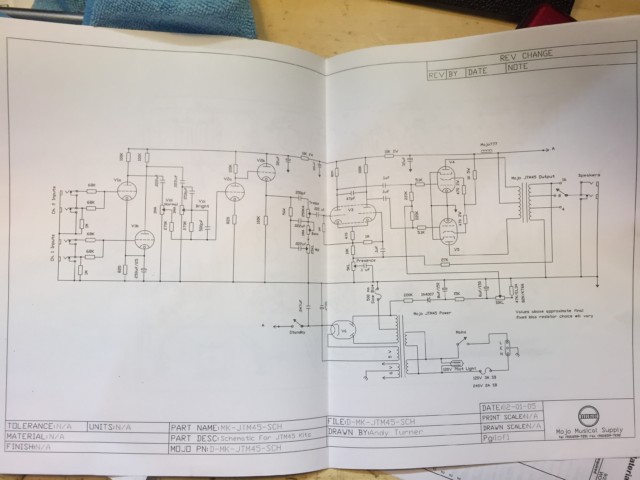
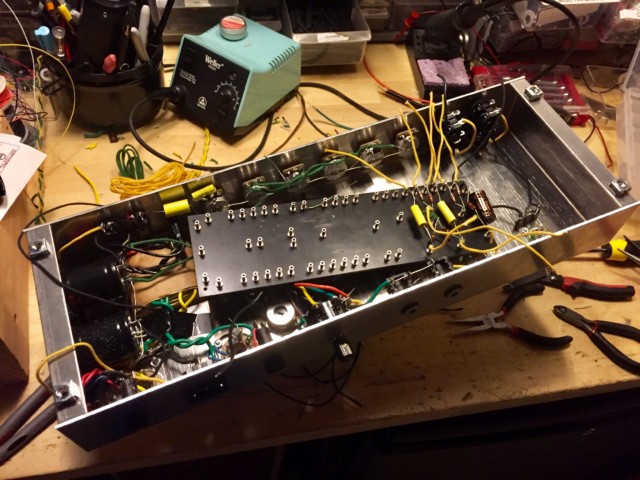
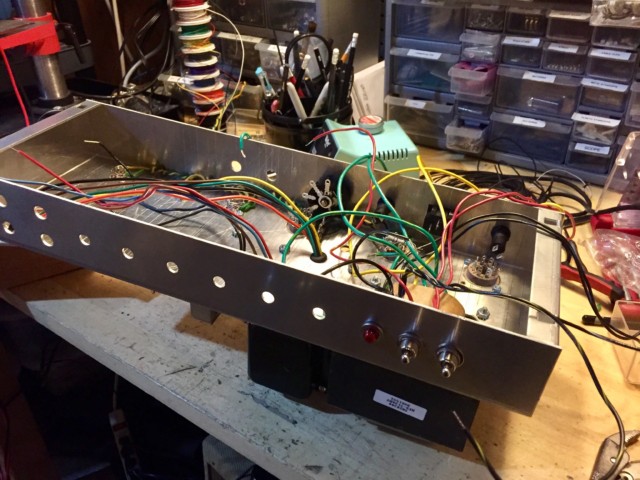
Mojotone provides high quality parts, nearly labelled and organized in plastic compartmented boxes. But beware: The company provides no build instructions — just a layout diagram and a schematic. You need amp building experience or help from an expert. Click play for a slideshow about he build:
This is Mojotone’s new offset head cabinet. (The amp chassis first in other Mojotone cabinets as well.)
The two power tubes can be either EL-34s or KT-66s. (I chose the latter, just for a new experience.)
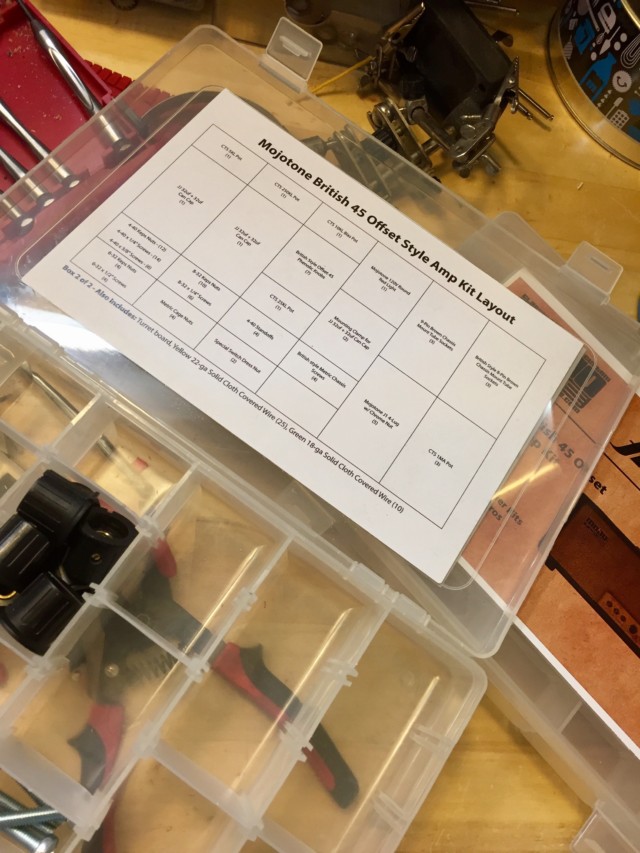
The parts come neatly labeled and organized in plastic bins — a BIG help!
Warning: the kit includes no build instructions — just this layout diagram and a schematic.
I ALMOST managed to assemble it, but I needed a rescue at the end. (Thanks to Bruce Clement of BC Audio, a brilliant boutique builder here in San Francisco.)
Mojotone supplies their own branded transformers (which sound fab).
It’s a turret board build. (The board and turrets are pre-made, as opposed to some kits, which require you to insert the turrets yourself.)
This is probably not a good first build — maybe start with a nice little tweed Champ kit?
The a plexi faceplate, which I left omitted. I also substituted my own knobs.
I nearly made it through myself. (Translation: I soldered everything together and it didn’t work.) So I had to hire Bruce Clement of BC Audio here in San Francisco to rescue me. (Bonus: Bruce loaned me one of his JTX50 heads. Man, it’s one of the best-sounding Marshall derivatives I’ve ever heard. It’s among his Octal-Plex series amps, which use octal preamp tubes in Marshall-inspired designs.) (more…)
Man, pontificating ain’t easy! KMI, who make the SoftStep controller I use almost every day, solicited a “Albums That Meant a Lot to You” list for their website, and I replied with “Ten Albums That Made My Head Explode,” which just went live on their site. And that made me want to hear your lists.
I don’t know why exercises like this can be so hard. First you can’t think of enough … and then too many … and then you worry you forgot an important one … and then you spend an hour reflecting on whether Joni Mitchell or Béla Bartók is more important … and then you read the whole thing through and realize how insufferably pretentious you sound. At some point, you just surrender and hit SEND. And that’s the moment you start second-guessing the whole thing.
For such a low-stakes effort, the pressure is high! And now I’m putting the pressure on you: I’d love to read your lists of mind-exploding music. Please post them to comments below, and add as much detail as you like. (And feel free to use the “runners up” dodge — I certainly did.)
I’m not sure if there’s much difference between “music that altered my mind” and “best music” lists. I guess it depends on how much importance you place on music that leaves brain specks all over your walls. For me, the brain-speck stuff usually is the best music.
I realized after the fact that only about half my picks have audible guitar parts. How about yours?
James Horner, one of the most successful film composers in Hollywood history, died yesterday after crashing his single-engine plane near Santa Barbara, California. He was 61.
It’s hard to pinpoint the highlight of Horner’s career — he scored such mega-hits as Titanic, A Beautiful Mind, Avatar, Braveheart, and many other films. But I can definitely point to a career lowlight: tutoring a struggling 16-year-old freshman music student in a musty, claustrophobic practice room at UCLA’s Schoenberg Hall in 1975.
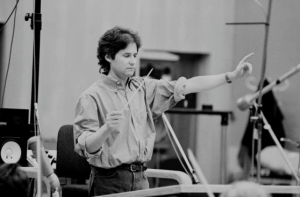
Seen here conducting his Braveheart score, Horner looks exactly as I remember him from 1975.
The tin-eared student was me — an incoming music major inadequately prepared for the rigors of college-level theory and musicianship. The TA leading my two-hours-per-day core class suggested I hire a private tutor to save me from sinking, and he recommended his fellow grad student, “Jamie” Horner. Borrowing a little extra cash from my folks, I paid Jamie some meager hourly fee ($10? $15, maybe?) to subject me to ear-training boot camp. It was basic music-major stuff: dictation (notating melodies and eventually counterpoint by ear alone), score-reading, sight-reading, sight-singing, and the like. (I needed the help! Then, as now, I was no “natural” musician. I labored mightily to acquire such skills.)
Jamie (as everyone called him then) was perfectly nice, but we weren’t pals or anything — he was just a busy and ambitious grad student earning a few quick, if measly, bucks via boilerplate tutoring of a slow student. He’s already embarked on his film scoring career, and his example was one of my earliest and most powerful eye-openers about the brutality of the biz.
Jamie was ridiculously gifted. He had laser-like focus on his goals. He was hereditary Hollywood royalty. (His dad was Harry Horner, an Austro-Hungarian émigré and famed production designer, and I think Jamie grew up with people like Otto Preminger as dinner guests.) And he was still ghost-writing scores for dog-shit films for next to nothing. For some, Jamie’s steep uphill path would have been an inspiration. But it scared me the hell away from his profession. (And today’s Hollywood scoring scene is vastly more brutal than it was back in the ’70s.)
I attended school during the last gasp of modernism. The focus was avant-garde 20th-century music, from Arnold Schoenberg to such then-leading lights as Luciano Berio, György Ligeti, and Witold Lutosławski. (You know — the ear-hurtin’ atonality that only perverts and music professors love.) Post-Romantic music was considered hopelessly tacky. No one studied Richard Strauss, especially his later, reactionary stuff! But I remember Jamie walking around with Strauss’s Alpine Symphony score under his arm. He was smarter than everyone else.
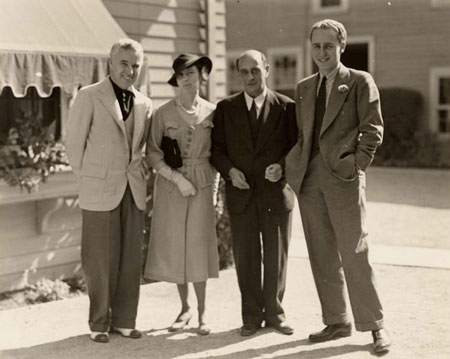
My favorite memory: A few years later in school, after I’d caught up and was doing okay, I had the unforgettable experience of taking a few semesters of David Raksin‘s film scoring class in the UCLA film department. Raksin was an amazing figure who worked with some of Hollywood’s greatest talents. (This photo sums up his significance. It’s Raksin on the right, posing with his teacher, frickin’ Arnold Schoenberg himself, Mrs. Schoenberg, and the man who gave David his first big break: Charlie Chaplin.)
Jamie dropped by Raksin’s class to meet David for a lunch date at the faculty restaurant. David kindly asked me along. (He’d taken a shine to me, not for any music skills, but because he liked what I’d written about scoring in my term papers.) So I got to tag along and listen to two geniuses talk shop. I just sat there trying not to say anything too stupid. I doubt I succeeded, but I’m grateful all these years later to have basked in their collective brilliance for a few minutes.
And I’m grateful to James Horner for helping me along. My heartfelt condolences to his family, friends, and colleagues.
I was kind of stoked about my latest wiring experiment: a “double Varitone” scheme I installed in my DIY “Kitschcaster.” I’ve written about these multi-capacitor tone switches a lot on this site, but this is the first time I’ve tried using a similar scheme to cut bass frequencies. The result is a lot like the G&Ls “PTB” circuit (covered here and at Premier Guitar), but with adjustable treble-cut and adjustable bass-cut.
The reason I say I was kind of stoked is, just as I was preparing this post, some fascinating marketing materials appeared in my comments queue. A manufacturer uploaded a barrage of marketing copy about his product, a prefab pickup-switching system. I visited the product site, and learned the most amazing thing: Unlike most of the stuff I write about here, his product can actually get you laid! No way can the double Varitone do that! Here’s how the product works: (more…)
One of the coolest gizmos from last weeks NAMM show is already in my grubby little hands: It’s the Logidy EPSi, the first customizable convolution reverb pedal. I ordered it the instant I heard about it, and it arrived right before I left for Anaheim.
Convolution (or impulse response) reverbs can mimic acoustic spaces and outboard gear with astonishing accuracy. (If this concept is new to you, check out this article by me. Or better yet, this one written by someone who knows what he’s talking about.) Nutshell: You create impulse response (IR) files by playing and recording a test tone in rooms or through gear. Once you load the file into an IR reverb device or plug-in, it can make anything sound as if it was recorded with the same ambience.You can also generate eerie, otherworldly sounds by loading unusual audio files.
Many software and hardware amp and effect modellers use IRs to mimic gear. Software convolution reverb plug-ins such as Audio Ease’s Altiverb, Logic Pro’s Space Designer, and Waves IR1 include reverb libraries, and also let you load your own IRs. But as far as I know, EPSi us the first device that lets you load your IRs into a stompbox and access them without playing through a computer.
I’m psyched to add IR reverbs to my (mostly) analog pedalboard, and EPSi makes it relatively easy to load the IR libraries I’ve compiled. The files require special treatment: They must be 44.1kHz WAVs, and the names must be formatted quite specifically, as detailed in Logidy’s documentation. The interface is extremely minimal: just a bypass footswitch and a knob/button pair to navigate the simple menus.
This unique reverb stompbox sounds great and offers limitless opportunities for creative sound design. You can load your own impulses, or add ones from from some of the fine freeware libraries online. (Thanks for the link, Scott!) On the downside, it’s difficult to load or edit sounds on the fly, so while it might be fun to spelunk for new sounds in the studio with EPSi, don’t plan on modifying sounds onstage. (The ability to recall several saved presets would vastly improve EPSi as a gigging tool.)