Categories
Effects guitar

Museum of Lost Effects:
Morley “Oil Can” Wah

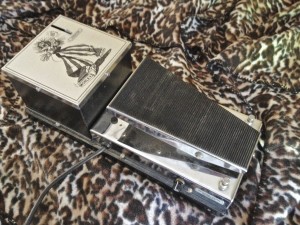
The mighty Morley Rotating Sound Wah

Two indisputable facts about Leslie rotating speaker cabinets: They sound awesome, and they’re approximately the size and weight of Rhode Island. Since the ’60s manufacturers have attempted to mimic the spinning-speaker effect in a more modest package. And one of the best mimics is the second exhibit in our Museum of Lost Effects.

The Morley Rotating Sound Wah is less well known than an earlier pseudo-Leslie, the Univox Uni-Vibe,forever associated with Hendrix. Like the Uni-Vibe, it a) tried to duplicate the Leslie, b) failed, but c) wound up creating a cool tone of its own. But while the Uni-Vibe milks its modulation from a series of optical sensors, the Morley relies on a rotating disc inside a can of electrostatic fluid. The result is a cool and complex modulation sound unlike any other (and one I’ve never been terribly successful at mimicking digitally).

This technology is descended from the “oil can” delays produced in the ’60s by the Los Angeles-based Tel-Ray company.In fact, Morley was a Tel-Ray spinoff — company founders Ray and Marv Lubow chose the name Morley for their line of guitar pedals based on the boast that this relatively compact modulation effect offered “more-lie,” as opposed to “less-lie.” (Note that I said “relatively” compact, since this beast is far and away the heaviest stompbox I’ve ever owned.)

The Morley Rotating Sound Wah is ugly, clunky, and klugey. If you drop it on your foot, you’ll never walk again. But I think it sounds incredibly cool.

Have a listen and see whether you agree:
Categories
Effects guitar

Museum of Lost Effects:
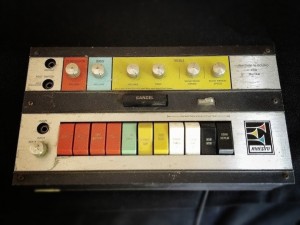
Maestro Rhythm ’N Sound for Guitar

Well, I’m not sure it’s fair to call it a “museum” when there’s only one exhibit so far. But it’s a really, really good one…

I bought this Maestro Rhythm ’N Sound for Guitar for a pittance back in the ’90s. It’s a primitive multi-effect unit from 1968, with a cool octave-down bass tone, auto-wah, and two fixed filters. It’s got fuzztone (though mine has always been broken), and a weird, choppy tremolo reminiscent of the Vox Repeat Percussion effect. (Mine worked fine — until I broke it yesterday while trying and failing to fix the fuzz. Kill me now.)

But the marquee feature of this hand-soldered contraption is the option of triggering four wonderfully cheesy analog percussion sounds. Bongo? Cymbal? Tambourine? Clave? At your command!

Does it sound as weird as it sounds? No — weirder!

You can’t assign specific specific notes to specific sounds — any input triggers the percussion, so the clicks and clanks tend to work best shadowing every note in a phrase, adding a weird edge. (I used them like that on Oranj Symphonette’s “Charade,” Erica Garcia’s “Yo No Tengo La Culpa,” and PJ Harvey’s “Maniac.”)

But then it occurred to me you could more ambitious things with the percussion sounds via looping. Which is exactly what I do in this short, fuzz-free video.

Check it out — and then let’s talk about this Museum of Lost Effects thing!

Categories
guitar

A Very Vintage Strat

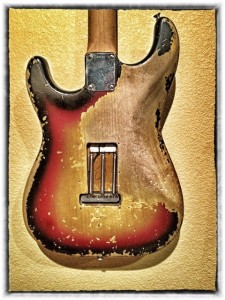
The ’80s were tough on guitars.

Last weekend I went to a memorial service for a music pal I hadn’t seen since the ’80s. Judging by the pictures I saw and the stories I heard, Brett remained the gentle, generous music lover I’d remembered till he died in his sleep a few weeks ago.

I ran into lots of old music friends and bandmates, and we alternately smiled and winced as our old photos and concert videos flashed on the big screen. Were we really that skinny? Did we actually wear that stuff without being coerced at gunpoint?

Like we tend to do at such moments, I left brimming with resolutions: Appreciate life. Cherish friends. Remember that music is a joy as well as a job. And do something nice for my sad old Strat, the guitar in all those old photos and videos.

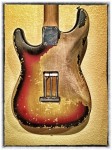
See, back then I only had one guitar — an all-original ’63 Strat I’d picked up in 1980, when pre-CBS Fenders were still perched on the precipice between collectible and affordable. (I paid $450, a staggering investment for me at the time.) It remained my only serious guitar for a decade. It was in near-perfect condition when I bought it, and it was a battered ruin by decade’s end. (The ’80s were a tough time for guitars, what with all those studded belts.) I was a young player with a bad attitude and little concern for collectibility, as opposed to the middle-aged player with a bad attitude and little concern for collectibility that I am today.

I’ll some thoughts about Strats then and now. But first, have a listen:

Categories
Acoustic guitar Recording

How Nashville High-Stringing Works

You don’t have to be high in Nashville to enjoy Nashville high-strung.

Nashville high-strung tuning is one of the guitar’s great magic tricks. It has a delicious, “secrets of the Guild” quality — you feel like an insider just knowing what it is.

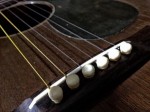
Not that I did know what it is until embarrassingly late in life. For the sake of my fellow late-bloomers, I’ll explain: You replace your guitar’s lowest four strings with thinner strings tuned an octave higher than normal.

You can think of it as using the higher-pitched of a each pair in a 12-string string set. (Or the top two strings of a normal set, and the top four strings from another normal set, with the first string as the third string, the second string as the fourth, etc.)

I love how this tuning can work subliminal magic, or step front and center for marquee riffs. Nashville session players conceived it as a way to add stereo shimmer to doubled acoustic guitar tracks. But rock players have used it to great effect as a foreground sound, as heard on the Stones’ “Wild Horses,” Floyd’s “Hey You,” Kansas’s “Dust in the Wind,” and Tracy Chapman’s “The Promise.”

Here’s a quick little demonstration, both solo and in a mix:

Categories
guitar Pickups

What’s the Deal with Alnico VIII Magnets?

Like this royalty-free clip-art illustration, the Alternative 8 manages to be both aggressive and round.

I was talking to some of the Seymour Duncan dudes the other day about pickups models deserving greater public awareness. One of the first names on everyone’s lips was the Alternative 8, a a high-output humbucker that uses a powerful alnico VIII magnet in lieu of the alnico II or alnico V magnets that fuel the vast majority of non-ceramic pickups.

I was intrigued, so I popped one into the bridge position of my Hamer 20th Anniversary. Yow.

If you’ve been following this blog, you’ve probably noticed that I tend to gravitate toward lower-output, vintage-flavored pickups, generating gain from the amp or a number of sketchy homemade distortion boxes. The Alternative 8, with its blistering DC resistance of 17.68k, is definitely a departure for me, but I found myself captivated by its deft balance of aggression and definition.

Have a listen and see what you think. Post-mortem after the video.

Categories
guitar Pickups

Mixing Magnets in One Pickup

Aggressive on the bass side, sweet on the top.

I was talking to Seymour the other day about the types of magnets used in vintage Fender pickups. I knew that Fender used strong, punchy alnico V magnets in most of their models, but I didn’t know that the earliest Teles used softer-sounding alnico IIs, or that the first Strats used even softer-sounding alnico IIIs, a detail confirmed by Fender’s page on the topic.

I recently had a chance to compare the sound of alnico II and alnico V while hacking together guitars for the Mongrel Strat Project. I’d tried an Alnico II Pro in the middle position of this mongrel, and liked it. But as I continued to experiment, I gravitated back to the more traditional alnico V sound — maybe because I play so much in lowered tunings, and in bands without bass, so I really like the strong, defined fundamental you get from an alnico V.

But until now I’d never tried literally splitting the difference via Duncan’s Five-Two, a hybrid that has three alnico V rods for the bass strings and three alnico II rods for the trebles. The idea behind this arrangement is to deliver a bold, snappy sound in the low resister, but with some softening and sweetness on top.

How does it sound? You tell me — here’s a demo video I made. Plus, there’s a micro-contest: The first person to name the tune I’m playing will have their name immortalized for the ages mentioned in an upcoming post. (That might be better than a poke in the eye, depending on whose eye it is.)

Have a listen:

Categories
DIY Effects guitar Pickups

Hello Kitty Strat: Not for Pussies!

Would this be anything less than awesome? I think not.

As I gloated last week, Jane Wiedlin gave me her Hello Kitty Stratocaster  — the most bitchin’ $99 guitar ever conceived! I finally had a chance to destroy/customize it yesterday, in what will no doubt be the first of many desecrations/enhancements.

I’d ordered one of those Synyster Gates Duncan Invaders with the pretty white pole pieces for the guitar, but just couldn’t wait to experiment, so I browsed through the ol’ pickup collection, and found a nice Duncan Phat Cat I’d used in a Les Paul experiment some months ago.

I don’t generally recommend choosing pickups because of their names, but come on! Kitty + Cat? How could I resist?

Turns out it was a lucky choice. I hadn’t planned to install a pickup that was actually lower in output than the stock humbucker, but it lets me get nicer clean sounds, and coughs up more than enough crunch when goosed with distortion. Speaking of which: the other custom feature is a built-in-distortion circuit activated via push-pull pot (I took lots of pics of the process for a DIY built-in-effects tutorial I’ll be posting very soon.)

View the carnage in this little video. Thanks, Jane Weidlin! Sorry, Stevie Nicks!

Categories
guitar Music Pickups

New Audio Player: Loud & Cloud!

Hi folks — I’m experimenting with a switch to the SoundCloud audio player. I’ve been eyeing it for a long time, but until now it’s been entirely Flash-based, which meant you couldn’t access SoundCloud clips from mobile devices. But they’ve just introduced HTML5 support, so I’m ready to make the plunge.

The clip is an accompaniment to the post below about using unspotted Seth Lover pickups with the expanded Phase 2 version of the Jimmy Page wiring scheme.

One of the coolest things about SoundCloud (beside the nifty waveform view) is the fact that it supports notes. Just click on the little icons beneath the waveform to read a description of which pickup settings are being heard at a particular point. Sweet.

Work for you? Computer? Phone? Tablet? Any comments or questions? (Thanks in advance for for your unpaid beta testing!)


Categories
DIY guitar Pickups

The Pagey Project: Postscript

Does this guitar LOOK like it has over a hundred settings?

Just a quick follow-up on the Pagey project, which first recreated the original Jimmy Page wiring scheme, and then explored an even  more extreme version using Seymour Duncan Triple Shot Mounting Rings.

Once I’d finished the project, I had to decide whether to keep the guitar heavily modded, or revert to something simpler. It probably won’t surprise you to hear I decided to keep the extreme Phase 2 wiring, with its added germanium overdrive.

But as cool as the Duncan ’59 model pickups sounded, I wanted to revisit the Duncan Seth Lover pickups I’d previously had in the guitar. They’re bright — twangy, even — compared to the ’59s, and I like the midrange honk they add by virtue of being unpotted. (I’ve written about the pros and cons of potting here.)

I’ve recorded an example of how the guitar sounds with the Seth Lovers. (You can’t make exact comparisons with the previous Pagey videos, since I used an amp for those, while the new examples were recorded through an amp simulator, though the “Seth” character still shines through.) I’ve included the clip in the post after/above this one, because it’s my first audio example using SoundCloud, and I wanted to say a few words about that.

"There's GOLD in that thar pickup!"

And call me shallow, but…I really dig the way my guitar looks with the Seth Lovers installed. Between the teensy switches on the mounting rings and the push/pull pots, you really have to look hard to tell the guitar is not merely non-stock — it’s a morbidly overdeveloped tweak machine.

Funny — I’ve always found gold hardware a little bit tacky. But now I’m so enthusiastic about the look of gold that I feel like this guy at the right.

Categories
Digital guitar Music Recording

A Loop-Oriented Laptop Guitar Rig

I haz a band.

My ol’ pals at Guitar Player magazine interviewed me for an instructional article on looping for next month’s issue. It was especially flattering to be invited, because the interviewer was Barry Cleveland, a fine guitarist and a leading figure in the looping community.

I put together this little video to demo the digital rig I use onstage with my duo band, Mental 99, and I’ve cross-posted it here. It covers software, hardware loopers, looping techniques, and the like. Have a listen.