Categories
DIY guitar

Kitschcaster: An Experimental Fender/Gretsch Hybrid

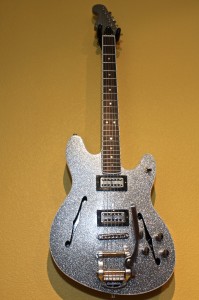
Kitschcaster front

I just completed my third DIY guitar experiment using Warmoth parts. This one is a wacky Fender/Gretsch hybrid with a semi-acoustic Fender Starcaster body, a reverse, angled Strat neck, and various Gretsch-like elements, including TV Jones Filter’Tron pickups, a Bigsby/Vibramate vibrato, and a vulgar silver-sparkle finish — a tribute to the Gretsch Silver Jet, and the basis for this new guitar’s name: Kitschcaster.

Mind you, it sounds nothing like a Starcaster. I ordered the body (which Warmoth calls the Mooncaster) in warm-toned korina, and the neck is mahogany. (Fender used bright-sounding maple for the original necks and bodies.) True to form, the Gretsch-style humbuckers provide a percussive, “plinky” attack quite distinct from PAF-style pickups. The Bigsby assembly also nudges things further from Fenderland. But I always dug the Starcaster’s offset semi-acoustic body, and I thought it would make a nice platform for my latest platypus.

As before, I’m 100% delighted with Warmoth’s work. The finish is flawless (correction: was flawless till I dinged it), and everything fit together beautifully. The only hurdle came when installing the wiring. I failed to take into account the body’s thinness, and I didn’t have enough room to accommodate all the big push/pull and dual-concentric pots I’d planned to deploy. The comic highlight of the build came when I somehow managed to force a standard-sized pickup selector switch into the narrow lower horn. I disconnected a wire while doing so, and then found myself completely incapable of removing the switch. I took it to repair genius Gary Brawer, whose first comment was, “How did you get this in here? And more important, why?” But he managed to free the trapped part, and then he installed a cunning little access cover. Go, Gary!
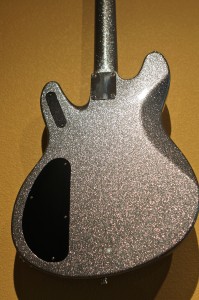
Kitschcaster back
Yes, the neck is silver too. Gary Brawer added the pickup selector access cover.

I’m especially besotted with Warmoth’s “Clapton” profile necks, which I’ve used in all three of my builds. They have a pronounced V shape that feels so comfy in my left hand, and provides relief for my left thumb joint, where, sadly, I’m feeling my first tentative twinges of arthritis. It’s a trip having three radically different guitars with identical neck profiles. I dig the sleek, comfy body as well, and I love its ability to generate musically coherent feedback.

Anyway, consider this a work in progress. I’m still fussing with the tone circuit. (If I can find suitably sized rotary switches, I want to try a sort of “double Vartitone,” with separate treble-cut and bass-cut dials. If it works out as as planned, I’ll do another post on it.) I’ll also probably jigger with the built-in distortion, taking off some of the treble. Like my Bigsby equipped Les Paul, the Kitschcaster can have overly aggressive highs. Something about the combination of the Bigsby hardware and flatwound strings makes certain notes come screaming out of the amp. Both guitars benefit from a carefully controlled touch.

But even now, I’m really stoked about this fun, cheesy-cool instrument.

Categories
Acoustic

Taylor 150e: An Affordable 12-String Acoustic

I needed a 12-string acoustic in a hurry for a session, so I picked up a new Taylor 150e for under $700. It wasn’t a review model or anything — I just ordered one online, sight unseen and sound unheard.

This model has been generating much buzz as an affordable yet good-sounding 12-string. It’s savvy positioning on Taylor’s part: I suspect there are many players who, like me, would love to have a nice 12-string, but aren’t about to spend $2,000+ for that occasional color. Anyway, I’m duly impressed. Have a listen!

I’ve got it strung with a super-heavy set from Pearse, and it’s a bit too macho for me. I dig the volume and harmonic richness, but it’s a beast to maneuver, at least for complex fingerstyle stuff. Either I’ll restring with something lighter, or consider testosterone supplements.

I haven’t owned a 12-string acoustic since I was 13. My first decent acoustic guitar was a late-’60s Fender Villager 12-string purchased for under $200. I loved it, but unfortunately, the shop that worked on it removed the tone bar, an essential brace. Uh oh — after a couple of weeks, I opened the case to find that the guitar had imploded on itself overnight. Instead I got a Yamaki 6-string, a crappy Yamaha knockoff. I’ve spent years in therapy working through the trauma.

The 150e is a Mexican-made instrument with a solid spruce top and a layered sapele body. I didn’t even realize till I received the guitar that it included onboard electronics. I almost never use that stuff, but before typing this, I went to plug it in. And guess what? It’s a surprisingly decent-sounding system that relies on an internal microphone. It doesn’t sound as good plugged in as it does in the video, but it’s totally acceptable for stage use. I didn’t expect it to sound half as good.

Anyone tried one of these? Any other acoustic 12-string recommendations, observations, or rants? What’s the coolest 12-string riff? And who’d win in a fight: Leo Kottke, Ralph Towner, or Leadbelly?

Categories
DIY Effects guitar

Museum of Lost Effects:
Interfax Harmonic Percolator

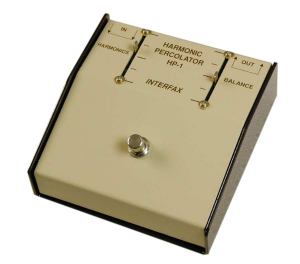
Few guitar pedals can rival the cult cachet of the Harmonic Percolator, a singularly ugly distortion stompbox produced in minuscule numbers in the early ’70s by Interfax, a small company based in Milwaukee, Wisconsin. And guess what? They sound ugly too, though they’re ugly in a cool and useful way.

They don't get much rarer — or uglier.
They don’t get much rarer — or uglier. (This is a cosmetically faithful reproduction from Theremaniacs.)

I’ve been wanting to write about these for years, but was hindered by the fact that I don’t have access to one. No one does! Well, except the pedal’s best-known user, producer/guitarist Steve Albini. (Steve has posted several popular YouTube videos in which he sings the praises of the original and evaluates it against modern clones.)

But I revisited the idea recently when Christian Magee, who runs Tube Depot, sent me a couple of old 2N404A transistors from a stash he recently acquired. This rare PNP germanium transistor appeared in the original, along with an NPN 2N3565 (also rare, but not as ridiculously rare as the 2N404A). Yes—this pedal uses both a positive-ground germanium transistor and a negative-ground silicon transistor in the same circuit. (Another Fuzz Face/Tone Bender clone, this ain’t!)

I whipped up several variants:

    • a clone using the original parts


    • a near-clone using more readily available alternatives


    • a Harmonic Jerkulator, an all-silicon/no-diodes variation created by DIY stompbox titan Tim Escobedo


    • an experimental version with extra controls

Survey the wreckage:

Post-mortem after the jump.

Categories
Acoustic guitar

Strange, Strange Strings

No longer ridiculously expensive — just REGULAR expensive.
No longer ridiculously expensive. Now they’re just very expensive.

I spent last week covering the Musikmesse musical instrument trade show in Frankfurt, Germany, for Premier Guitar. I had a blast, and Chris Kies and I posted details and pics of more than 70 new products. (Here’s the short list of our personal faves.) Kies shot lots of video, and will be posting more than 50 demo segments to the PG site in the coming weeks.

But Messe is hellishly loud, far noisier than NAMM. When I finally got home and picked up a guitar, it was an acoustic. I was trying something new, based on info I obtained from Mary Faith Rhoads-Lewis, CEO of Breezy Ridge, a company that distributes several brands for acoustic musicians, including John Pearse strings.

I’d previously geeked out here about about the strangest and most expensive guitar strings I’d ever tried: this “rope core” set from Austria’s Thomastik-Infeld. Reader/cool guy Al Milburn turned me on to them, and I wrote about them here. And I recently posted this video demonstrating how the transformed my old Martin 0-17 into a compelling steel/nylon hybrid with a unique and expressive voice.

Anyway, Ms. Rhoads-Lewis told me that the late John Pearse originally created this set for Thomastik, and that the John Pearse Folk Fingerpicking set [PJ116] is identical to what the Austrian company sells. Best part: You can get them in the States for under $20, as opposed to a walloping $35 for the Thomastiks. She also told me that their magic works in reverse: You can put this relatively low-tension set on a classical guitar for a very different sort of hybrid steel-string sound. (This, she said, is exactly what the great Brazilian player Bola Sete used to do.)

I popped a set on my old Yairi classical. The feel was — totally strange, and in precisely the opposite way as on the Martin. The tone was edgy and exciting, but the tension seemed a little too extreme. If just seemed a little too … high-strung, in every sense. Then I tried lowering the entire tuning a whole step, with the sixth dropped all the way to C.

And … oh, my. Check it out:

Summary: Holy cannoli, I love how this sounds. And there’s something psychologically satisfying about the transformation too. See, this guitar has always been a bit … tragic to me. I got it when I was 16. My classical guitar prof at UCLA said I needed a better instrument, and my every-supportive folks, bless ’em, helped me buy this Alvarez Yairi for around $700 (in 1970s dollars). It was a top-tier model for Alvarez, signed by luthier Kazuo Yairi, and boasting lovely Brazilian rosewood backs and sides. It was a huge upgrade for me, but as I got deeper into classical playing, its shortcomings emerged. Had I not shifted my studies to composition, I’d have needed to upgrade again. I envied the Igancio Fleta y Hijos models my two teachers played, but at around $3,000, they were beyond my budget, even with parental help. (Pity — their current value is approaching $50,000.) So I’ve used this instrument as a limited but decent-sounding model suitable for pop work, if not serious classical concertizing.

Categories
Effects guitar Recording

Logidy EPSi Review:
The First Customizable Convolution Reverb Pedal

One of the coolest gizmos from last weeks NAMM show is already in my grubby little hands: It’s the Logidy EPSi, the first customizable convolution reverb pedal. I ordered it the instant I heard about it, and it arrived right before I left for Anaheim.

Convolution (or impulse response) reverbs can mimic acoustic spaces and outboard gear with astonishing accuracy. (If this concept is new to you, check out this article by me. Or better yet, this one written by someone who knows what he’s talking about.) Nutshell: You create impulse response (IR) files by playing and recording a test tone in rooms or through gear. Once you load the file into an IR reverb device or plug-in, it can make anything sound as if it was recorded with the same ambience.You can also generate eerie, otherworldly sounds by loading unusual audio files.

Many software and hardware amp and effect modellers use IRs to mimic gear. Software convolution reverb plug-ins such as Audio Ease’s Altiverb, Logic Pro’s Space Designer, and Waves IR1 include reverb libraries, and also let you load your own IRs. But as far as I know, EPSi us the first device that lets you load your IRs into a stompbox and access them without playing through a computer.

I’m psyched to add IR reverbs to my (mostly) analog pedalboard, and EPSi makes it relatively easy to load the IR libraries I’ve compiled. The files require special treatment: They must be 44.1kHz WAVs, and the names must be formatted quite specifically, as detailed in Logidy’s documentation. The interface is extremely minimal: just a bypass footswitch and a knob/button pair to navigate the simple menus.

This unique reverb stompbox sounds great and offers limitless opportunities for creative sound design. You can load your own impulses, or add ones from from some of the fine freeware libraries online. (Thanks for the link, Scott!) On the downside, it’s difficult to load or edit sounds on the fly, so while it might be fun to spelunk for new sounds in the studio with EPSi, don’t plan on modifying sounds onstage. (The ability to recall several saved presets would vastly improve EPSi as a gigging tool.)

Categories
DIY guitar

Bigsby + Vibramate + Les Paul

It’s a holiday miracle! The 30-minute Bigsby tremolo installation.

Sometimes it pays to write for a guitar magazine!

My old pal and Premier Guitar colleague Andy Ellis hipped me to the Vibramate, an adapter that allows you to install a Bigsby tremolo on many types of guitars with no drilling or other permanent modifications to your instrument.

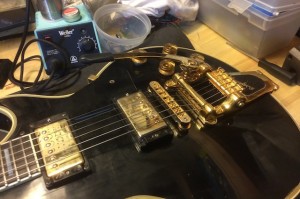
A Bigsby and Vibramate were a centerpiece of a cool makeover project the magazine concocted, transforming a beat-up ’70s Epiphone in a bitchin’ Bigsby-bedecked bombshell. Inspired, I decided to give myself the shakes for Xmas. I bought a Bigsby B7 and corresponding Vibramate kit and popped them onto my long-suffering Les Paul. Check it out:

Yup, this is the much abused ’82 Les Paul that I’ve used in many tonefiend experiments, especially the OCD-approved Pagey Project. What a journey this guitar has been on! Never a big Les Paul fan, I picked up the cheapest old one I could find because I needed it as a reference for the sound design work I was doing for Apple. Trust me — it was a thoroughly unremarkable instrument. But then I started playing with pickups … and alternate wirings … and replacement hardware … and after several years of hacking, I have an instrument I love.

Pity about the gold hardware though — I should have switched to chrome early on. It’s the downside, I suppose, of incremental makeovers. By the time I got to the Bigsby, I had to cough up extra cabbage for the vulgar finish. (My wife recoiled when she saw the Bigsby box on the counter: “Eww — what’s this gold thing?”)

IMG_0361
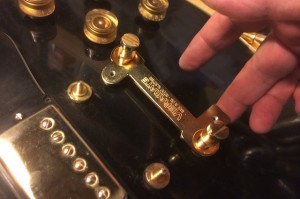
The Vibramate bracket screws into the existing tailpiece bushings.

I’m no Bigsby expert. I’ve never owned a Bigsby-fitted guitar (though I’ve had a couple of long-term loan). It’s odd, because I like how they perform, look, and feel, and “bling cringe” aside, I love it on this guitar. It definitely changes the tone — though in spectacularly unscientific fashion, I replaced the previous roundwound strings with flatwounds while doing the installation, and it’s tricky to sort out which changes are exclusively related to that hardware, and which to the strings. The guitar feels brighter and more resonant. (I’m reminded of Ry Cooder’s dictum: The more springs you add to a guitar, the livelier the acoustic response.) The treble response is WAY different — I needed to lower the treble sides of the pickups to offset the face-slapping response of the high E string.

I’ve bored everyone to tears with my incessant testimonials to the glory of great flatwound strings. This guitar has never worn flats — I’ve kept it in roundwounds for writing product reviews, and for sessions where I specifically need a roundwound sound. But I’m loving the way they sound and feel here, so I guess I’ll have to select another Gibson-flavored guitar as a dedicated roundwound instrument.

The installation was a breeze. The quality of materials is superb. I also added Vibramate’s String Spoiler, a clever little bracket that clips onto the tiny nubbins that usually secure strings to a Bigsby. The Spoiler makes string changes way easier. I’m deeply impressed by the Vibramate products — even in frickin’ gold.

Oh — the demo tune is the late John Barry’s wonderful Midnight Cowboy theme. Berry wasn’t a guitarist, but he contributed so much to the guitar vocabulary through his scores, especially for the early James Bond films. I was privileged to interview Barry for Guitar Player back in the ’90s. What a cool and brilliant musician!

Categories
Digital guitar Technique

Cue the Drummer Jokes!
Playing Drums with MIDI Guitar

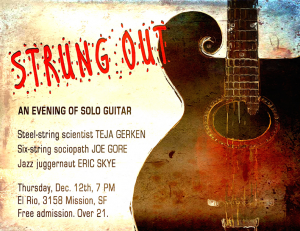
strung_out_121213_small

I’m thrilled to bits about a show I’m playing Thursday eve in San Francisco featuring two guitarists of impeccable skill and taste, plus me.

Teja Gerken and I are co-hosting a monthly solo guitar night at El Rio, my groovy neighborhood dive.Our guest is the amazing Eric Skye who, among other things, plays gorgeous solo guitar versions of classic Miles Davis tunes. If you happen to be in cold, cold San Francisco this week, stop by and say hi!

I’ve been doing the digital looping thing with Mental 99 for a few years now, and man, trying to work out solo arrangements with live-looped MIDI drums has been seriously humbling. You know all those jokes we love about how drummers speed up, slow down, drool, and generally disappoint? I can do all those things and everything else a drummer does, except occasionally play a competent groove. Some of the problems have to do with MIDI tracking in general, and some are simply general suckage. Man, it sure makes me appreciate my brilliant musical partner Dawn Richardson, who never speeds up and drools only rarely.

animal_drums

But those who can’t, teach. So I whipped up a little tutorial on playing drums with MIDI guitar. The first half covers the moves, and the second half features a live improv based on my fave afrobeat pattern. (Tony Allen is my rhythm god.) It also includes some of the hybird synth/guitar sounds I’ve been exploring, like double single-not lines an octave lower, mixing trashy guitar and trashy organ, and of course, space pigeons. (I stole the organ line from my pal Robin Balliger.)

In other news: I’ve been speaking to the ultra-knowledgable Rob Hull from Tube Depot about creating a minimalist DIY amp kit inspired by our conversations here. Lots more details to come. Tube Depot has a track record of making real nice amp kits, and Rob’s documentation/build instruction are the best in the biz. I reviewed their cool tweed Champ clone kit here.

Oh — anyone score any good holiday presents yet?

Categories
DIY Effects guitar

The Lipstick Lab
New Experiments with Old Pickups

Do you ever get an idea that you just know is going to work out brilliantly? And then discover you were totally wrong?

That’s how it was when I finally reassembled my generic Mexican Strat with Duncan lipstick tube pickups. After I recorded a demoing of it here almost two years ago, the guitar lay in pieces alongside my workbench. I’d stare at decapitated body, feeling guilty and dreaming of all the fantastic mods I’d attempt when I finally got around to reanimating it. I had various ideas for the tone control: Maybe a two-band PTB control? Nope—totally underwhelming results. Perhaps a two-in-one TBX? Meh—even less interesting. I drew a blank, and the guitar wound up with a disappointingly normal tone circuit.

But I did discover some cool twists along the way. Details after the video:

My flatwound string addiction is only getting worse, but this is the first time I’ve combined flats and lipstick tubes. (Has anyone done that since the ’50s?) The results were fascinating. As happens when you put flats on an electric 12-string, you encounter a paradoxical increase in highs, despite the darker-toned bass strings. (Maybe it’s because the treble strings ring truer with less phase-canceling interference from roundwound bass strings.) As you can hear, this instrument doesn’t lack for zing.

The opposite, actually — treble notes explode from the instrument, often more than you’d like. I experimented with various action and pickup height adjustments, but no matter how I set things, it was difficult preventing certain notes from shrieking. The only solution was to play the damn guitar for a few hours and grow accustomed to the touch.

Categories
Effects guitar

Phasers That Stun

phaser_stun


UPDATE: My Premier Guitar Heptode Virtuoso review is live. Read and listen here.

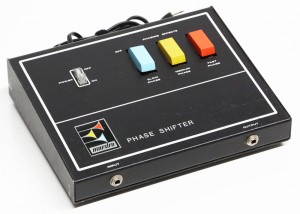
I’ve got phase shifters on the brain, especially after encountering a couple of truly stunning ones. I just wrote a review for Premier Guitar of Heptode’s Virtuoso phaser, a superb clone of the old Maestro PS-1A. (I’ll link to the review when it goes live.)

It took me back to my Pleistocene pre-teen years, when I once spent hours in my local music shop playing an electric nylon-string through a big-ass PS-1A mounted on a music stand. Despite its size, it had few controls — just big colored switches that could have been swiped from one of the era’s cheesy home organs. It sounded glorious to my 12-year-old ears. I’ve never since held such a high opinion of my own playing.

I haven’t played a PS-1A since then, but the Heptode pedal took me right back. It really is a gorgeous-sounding phaser, and one that vanished soon after the debut of the cheaper, smaller, and awesome-sounding MXR Phase 90. The sound captivated me all over, though I’m not sure if I actually like it more than the Phase 90, or if it just sounds so cool because it’s a less familiar color.

The plastic switches make it sound better.

I dug out a few other favorite phasers, like the $89 BYOC Phase Royale that usually lives on my analog pedalboard. It’s yet another brilliant DIY kit from BYOC’s Keith Vonderhulls. It’s basically a Phase 90, but with all the cool mods, like mix and resonance controls, plus a six-stage phasing option. (The Phase 90 and the Uni-Vibe are four-stage, while the Maestro is six-stage). It’s a fun build, and an excellent next step for DIYers who have built a few fuzzes and are ready for something a bit more challenging.

I concluded my little phase-fest by unearthing my old Lovetone Doppelganger, a bitchin’ dual-LFO phaser from the late ’90s. Not to be confused with today’s Lovepedal brand, Lovetone was a British company run by Dan Coggins and Vlad Naslas. They specialized in large-format pedals with an almost absurd number of controls. (Their brilliant slogan — “Big Pedals to Trip Over” — is rivaled only by Zachary Vex’s “Crazy Effects for Rich People.”) I’d flip out when each new Lovetone pedal came in for review at Guitar Player. Even then, they were expensive, usually in the $400-500 range. Now, of course, they’re obscenely rare and valuable. I bought as many review models as I could afford, and to this day I regret not purchasing their Meatball, Wobulator, and Brown Source. I did, however, snag the Big Cheese, Flange with No Name, Ring Stinger, and this guy:

I haven’t heard the Doppelganger in years, and it was interesting to revisit it. See, while I always loved the ideas behind the Lovetone boxes and was happy to own them, I’d found that I just didn’t tend to use them a lot for gigging and recording. For me, they had tons of cool sounds, but often not quite the right one. But I’ve gotten better at dialing in tones in recent years, and really dug the sounds I got yesterday while making the video. Maybe it just took me 15 years to learn how to wrangle these beasts!

Anyway, the Doppelganger is now a Museum of Lost Effects inductee, and it’ll be joined soon by its big-box brothers.

Categories
Effects guitar Music Recording Technique

The WRONG Way to Use a Talk Box

Any talk box fans out there?

Whew. Didn’t think so. I mean, doesn’t everybody hate those godforsaken things? Wasn’t it all downhill after “Tell Me Something Good?”

But did you know that the “talking guitar” has a rather exalted history four decades pre-Frampton Comes Alive? Check out this performance by Alvino Rey, the steel guitar genius who pioneered the technique.

I am TOTALLY going to have nightmares about Stringy for the next 10 years!

Rey worked his magic in tandem with his vocalist wife. She supposedly stood behind a curtain with a mic attached to her throat, the output of which modulated the guitar signal. (That’s what online sources say, though it sounds a bit fishy to me.) A similar technique — or perhaps the same one — was known as the Solovox. In this case, a small loudspeaker attached to the singer’s throat, “playing” the music through the vocalist’s mouth. More amazing/horrifying evidence:

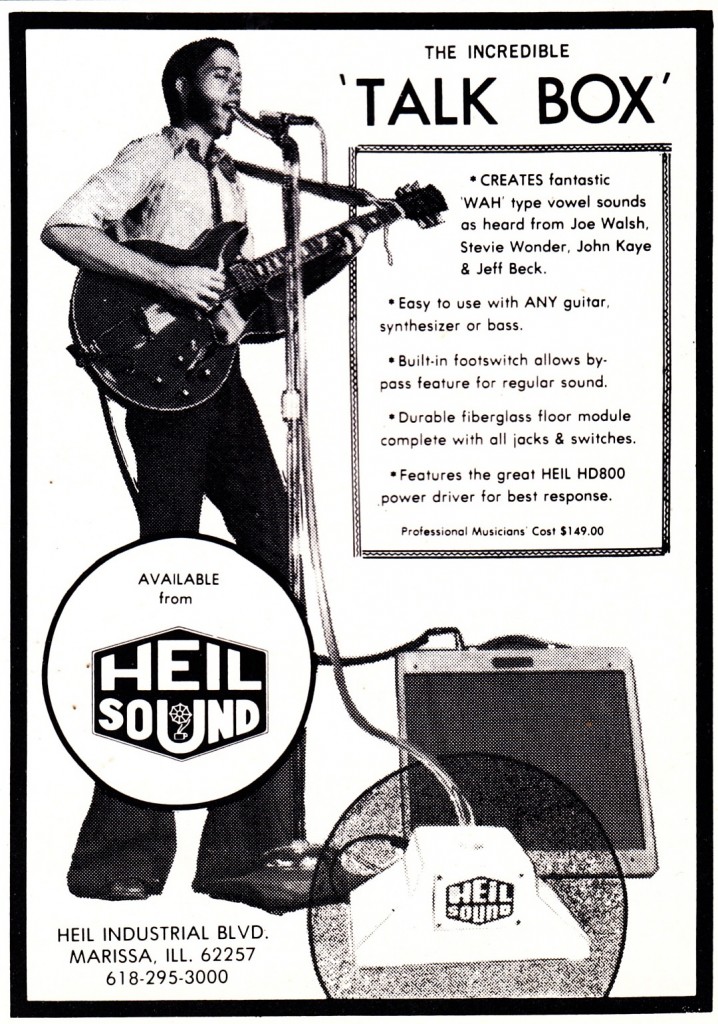
That’s the basic principle behind the rock-era talk boxes, though they rely on a plastic tube inserted into the mouth rather than a mic pressed to the neck. The first commercially available model was Kustom’s The Bag from 1969, “immortalized” on Steppenwolf Live. The Heil Talk Box — the version of the effect most of us know and loath — debuted in 1973. Dunlop is still making them.

But I have a perverse affection for the Rocktron Banshee. It’s incredibly loud. It’s actually a small amp, quite capable of driving a speaker cab, with a blunt-force distortion tone. That extra power is useful for my preferred way of using a Talk Box:

How about you guys? Anyone have anything good to say about the talk box?

Heil_TalkBox_1974