Categories
DIY guitar

Telecaster Deluxe Variations: Six Pickups and Some Weird Wiring

Fender’s Telecaster Deluxe has had an interesting and checkered history. Once regarded as yet another mediocre product from the company’s era of CBS ownership, these turn-of-the-seventies instruments now fetch huge prices on the collector’s market. I’ve never owned own. But when singer/songwriter Greer Sinclair loaned me one of Fender’s 2010 reissues, it was time for research — and experimentation.

The made-in-Mexico 1972 Deluxe reissue is a cool guitar. It replicates many details of the original: the oversized headstock, the Strat-like belly cut and fixed Strat-style bridge, and the big-ass pickguard. But its pickups are definitely a departure. In lieu of the original’s large-format “Wide Range” pickups, it employs a P-94R (a humbucker-sized P-90 spinoff) at the neck, and a conventional Gibson-style humbucker at the bridge.

The Wide Range pickup was a unique beast. Fender had commissioned Seth Lover, the man who invented the Gibson humbucker, to create a Fender humbucker in hopes of cashing in on the growing popularity of hard rock. With DC resistance in the 10k range, the new Wide Range pickup was a bit hotter than a vintage Gibson humbucker. Wide Range pickups appeared in several of the era’s models, including the Tele Thinline, Tele Custom, and semi-hollowbody Starcaster.

Gibson humbuckers have a bar magnet within, but the pole pieces are not magnetic. But on Wide Range pickups, the pole pieces are magnetic, as on Fender’s single-coil pickups. Situating individual magnets closer to the strings yield a brighter sound with greater note defition and string-to-string separation — characteristics we associate with vintage Fender pickups. So the Wide Range pickup lent a uniquely “Fender” twist to the Gibson design.
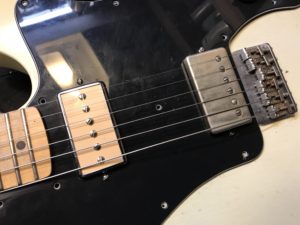
Wide Range pickups are slightly larger than conventional humbuckers. Most of Fender’s circa-1970 Tele reissues substitute generic humbuckers of the standard size. Standard humbuckers can sound superb in a Tele, but they’re horses of different colors. Fender has also created some reissues with the larger-sized pickups, but these are also garden-variety humbuckers — the larger format is purely cosmetic. The pole pieces of the factory humbucker on Greer’s guitar don’t align with Fender’s wider string spacing. (But one thing I’ve leaned from my various Fender/Gibson hybrid experiments is that sonically, this can matter very little.)

The P-94R’s cream-colored top looks wicked against the guitar’s finish. It’s a warm, full-sounding pickup from the mellower side of the P-90 spectrum. Actually, it doesn’t sound all the different from a traditional Telecaster neck pickup. (Like that pickup, it works quite well for jazz.) Note, though, that its dimensions differs substantially from those of a Gibson P-90, as you can the in the photo where it sits alongside a historically accurate Lollar P-90. When you change the size of a pickup’s components, you inevitably alter the sound. The tones can be for better or worse — but they will be different.

Categories
Pickups

Ten Unusual Strat Pickups Tested

I should have been out buying nice presents for you all. Instead I sat around inhaling solder fumes. When the smoke cleared (mostly, anyway) I’d tested ten unusual Strat pickups in the same poor guitar.

Tested pickups sets:

Jason Lollar Gold Foils
Lindy Fralin Big Singles
Seymour Duncan Antiquity II Mini-Humbuckers
Jason Lollar Staple/P-90 set
Allparts Gold Foils

Verdicts? I dig them all, and not just ’cause I’m too polite/chicken to say otherwise.

I love the Lollar Gold Foils so much I’m assembling a new parts guitar to surround them. I’m going to keep the Fralin Big Singles in the demo Strat, at least till the next Mongrel Strat Project. I’m going to try putting the mini-humbuckers in a “parts” Tele at some point. I originally reviewed the Lollar P-90 set for Premier Guitar (where I evaluated them the “right” way: in a Gibson guitar), so they go back to manufacturer, though I’d sure like to own a set someday. Meanwhile, the Allparts set isn’t in the same league as its high-end competitors, but at a mere $30 per pickup, it costs about 1/4 the price of its expensive rivals. You could definitely do a lot of lo-fi damage with a pair of these surprisingly solid-sounding pickups!

This article joins the long list of experiments in the Mongrel Strat Project archive.

And how about you? Have you but stuffing any pickups into places where they don’t belong? Maybe that’s why Santa left you sucky presents this year.

Categories
guitar

The PAF Strat

As threatened, here’s a closer look at Strat with PAF humbuckers used for my recent “God Only Knows” cover. Most parts are from the long-suffering guitar used for all the Mongrel Strat Project experiments. And this one is especially mongrel-ific, with its blend of vintage Fender and Gibson.

Obviously, Gibson pickups is a Strat is far from a new idea. But usually, that arranged marriage is designed to spawn macho, high-gain solos minus the characteristic shrillness of vintage Strat bridge pickups. While many players I love have used humbucker-equipped Strats, I’ve always loathed playing them myself. But what, I wondered, if you didn’t use a hot humbucker, but an über-vintage PAF?

Like many players my age and younger, I was astonished when I first encountered a vintage-voiced humbucker. It was nothing like the dark, over-overdriven tones I associated with the word humbucker. A good PAF is sparkly, resonant, and perfectly capable of gloriously bright and clean tones. Here I used a Seymour Duncan Joe Bonamassa signature set, the same one heard in a more Gibson-like context here.

The results are … compelling. As expected, notes have far more mass than on a conventional Strat, and the bass response is vastly increased. There’s no shortage of top-end either, though the big lows can overwhelm the highs at times. So while I’m pretty much always obsessed with bass-cut controls (especially the high-pass section of the PTB circuit I’ve written about approximately 37 zillion times), it’s especially invaluable in this case. Since lows disproportionately drive distortion, even modest bass cuts clean up the tone and make highs speak more clearly.

I’ve also incorporated the dual-capacitor treble control I wrote about here. It creates a Vari-Tone/ToneStyler effect in a simplified way: Instead of using a clunky rotary switch to choose from a large set of treble-trimming capacitors, it fades between a large cap and a small cap, yielding the same resonant effect as the more complex options. I’ve incorporated this circuit in several guitars now, and it’s still working for me. It’s especially nice here, when paired with a Steinberger JackPot potentiometer, which lets you bypass the entire tone circuit for absolute maximum volume and brightness. I chose the small cap based on the minimum amount I’d ever want to remove from the signal, and the larger one based on the maximum cut I’d use.

I would have included a photo of the project in progress, but I didn’t because I’m embarrassed about how awful it looks inside. I needed to route out the pickup cavities to accommodate these larger pickups. But instead of taking it to a professional, or getting a proper router and learning how to use it, I chipped away with the tiny routing bit on an inexpensive Dremel tool. Do yourself a favor, kids, and don’t follow my lazy-ass example.

But hey, what’s a Strat pickguard for if not to conceal your shoddy workmanship? The guitar looks okay in the end, and I’m digging its sounds, even though it was far harder to get accustomed to than I’d anticipated. I had to recalibrate my right-hand dynamics to prevent treble notes from screeching. I was almost ready to chalk this up as a failed experiment, but after a few days of noodling around, I started to get the hang of it and enjoy the results. I think I’ll keep it this way for a while — or at least until the next Mongrel Strat concept wafts up from the bowels of Hell. 🙂

Categories
DIY guitar

My Top Three Wiring Mods

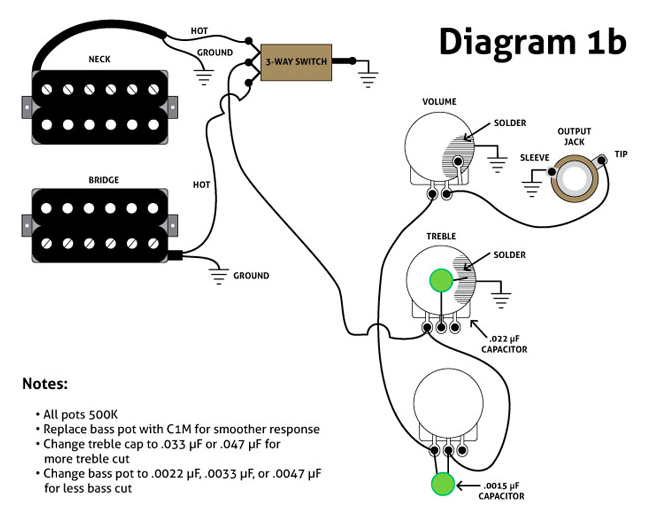
Premier Guitar just posted my new article on three favorite electric guitar wiring mods. The concepts won’t be new to anyone who hangs out here — I’ve pretty much flogged them all to death! But the new article includes the step-by-step walkthroughs that I never got around to creating for this site, and PG art director Meghan Molumby created beautifully clear tech diagrams like this one:


Screen Shot 2014-07-23 at 9.54.35 AM

The descriptions and instructions in the new story are clearer and more detailed than my original posts here, plus I’ve refined some details, so I suggest working from the new PG versions.

My three choices:

Yup, the ol’ PTB tone control, the coolest mod I know, at least for players who love distortion. The new version of the project uses the 500K pots you probably already have in your guitar rather than the more eccentric G&L values.

I also revisited the Strat version of the “Nashville-style” Tele wiring popularized by Brent Mason and other Music City cats. It performs brilliantly in a Strat, and IMHO its benefits (vastly more blended-pickup options plus a musical and intuitive control layout) for outweigh the costs (loss of the middle-pickup-alone setting, cost of a 3-way switch). Not to launch a protracted Strat-vs.-Tele battle, but I love the whole notion of “Tele-fying” a Strat via wiring, control layout, and pickup choice.

In the article’s comments thread, several savvy readers also mention Strat wiring systems that provide the sounds of the Nashville mod without sacrificing any others. They’re right — but the more I mess with this stuff, the more I value simplified operation. I’m less concerned with having all options than with having the coolest ones, ergonomically organized. Still, there are many ways you can go here.

Finally, I’m once more beating the dead Varitone horse exploring variations on Gibson’s Varitone concept, updated for modern players. I added a new twist in the PG story: deploying these ideas via toggle switches, rather than a big, clunky rotary switch.

It was fun when PG editor Shawn Hammond asked me to choose my favorite mods. It was easy to decide though — these are the three I keep coming back to, and all three deliver dramatic results, unlike many better-known mods.

So which electric guitar mods would be on your short list? Wiring, hardware, whatever. How do you make your guitars cooler?

Categories
DIY guitar

Bigsby + Vibramate + Les Paul

It’s a holiday miracle! The 30-minute Bigsby tremolo installation.

Sometimes it pays to write for a guitar magazine!

My old pal and Premier Guitar colleague Andy Ellis hipped me to the Vibramate, an adapter that allows you to install a Bigsby tremolo on many types of guitars with no drilling or other permanent modifications to your instrument.

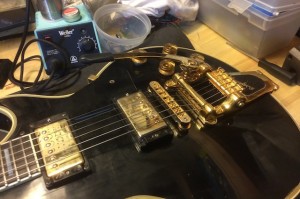
A Bigsby and Vibramate were a centerpiece of a cool makeover project the magazine concocted, transforming a beat-up ’70s Epiphone in a bitchin’ Bigsby-bedecked bombshell. Inspired, I decided to give myself the shakes for Xmas. I bought a Bigsby B7 and corresponding Vibramate kit and popped them onto my long-suffering Les Paul. Check it out:

Yup, this is the much abused ’82 Les Paul that I’ve used in many tonefiend experiments, especially the OCD-approved Pagey Project. What a journey this guitar has been on! Never a big Les Paul fan, I picked up the cheapest old one I could find because I needed it as a reference for the sound design work I was doing for Apple. Trust me — it was a thoroughly unremarkable instrument. But then I started playing with pickups … and alternate wirings … and replacement hardware … and after several years of hacking, I have an instrument I love.

Pity about the gold hardware though — I should have switched to chrome early on. It’s the downside, I suppose, of incremental makeovers. By the time I got to the Bigsby, I had to cough up extra cabbage for the vulgar finish. (My wife recoiled when she saw the Bigsby box on the counter: “Eww — what’s this gold thing?”)

IMG_0361
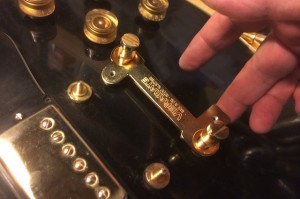
The Vibramate bracket screws into the existing tailpiece bushings.

I’m no Bigsby expert. I’ve never owned a Bigsby-fitted guitar (though I’ve had a couple of long-term loan). It’s odd, because I like how they perform, look, and feel, and “bling cringe” aside, I love it on this guitar. It definitely changes the tone — though in spectacularly unscientific fashion, I replaced the previous roundwound strings with flatwounds while doing the installation, and it’s tricky to sort out which changes are exclusively related to that hardware, and which to the strings. The guitar feels brighter and more resonant. (I’m reminded of Ry Cooder’s dictum: The more springs you add to a guitar, the livelier the acoustic response.) The treble response is WAY different — I needed to lower the treble sides of the pickups to offset the face-slapping response of the high E string.

I’ve bored everyone to tears with my incessant testimonials to the glory of great flatwound strings. This guitar has never worn flats — I’ve kept it in roundwounds for writing product reviews, and for sessions where I specifically need a roundwound sound. But I’m loving the way they sound and feel here, so I guess I’ll have to select another Gibson-flavored guitar as a dedicated roundwound instrument.

The installation was a breeze. The quality of materials is superb. I also added Vibramate’s String Spoiler, a clever little bracket that clips onto the tiny nubbins that usually secure strings to a Bigsby. The Spoiler makes string changes way easier. I’m deeply impressed by the Vibramate products — even in frickin’ gold.

Oh — the demo tune is the late John Barry’s wonderful Midnight Cowboy theme. Berry wasn’t a guitarist, but he contributed so much to the guitar vocabulary through his scores, especially for the early James Bond films. I was privileged to interview Barry for Guitar Player back in the ’90s. What a cool and brilliant musician!

Categories
Pickups Uncategorized

Happy Humbucker-Sized P-90s!

Happy-P-90s

Just in time for the single-coil holiday season: my comparison review of 16 humbucker-sized P-90 pickups is live at Premier Guitar. This heartwarming holiday fun-fest has it all: Mouth-watering adjectives. Freshly baked audio clips. Irate manufacturers. Don’t miss it!

This was a fun, if challenging project. Comparison pickup reviews are such cans of worms! Not only are they sadistically labor-intensive, but the differences between one pickup and the next are easily overshadowed by other variables in the tone chain.

After much thought about how to create meaningful comparisons, we came up with an intriguing process: I tested all the pickups in the same guitar, with identical setups, and ReAmped them through the same combo amps with identical recording settings. If this were an amp or pedal review, I would have used the same performances throughout, but of course, each example had to be played anew with each pickup, so I spent much time matching performances to guard against misleading variations in touch and intensity. It’s not a perfect solution, but better than most, and in the end quite revealing.

And what did it reveal, exactly? You’ll find out at the link. Beyond that, I can report that:

  • All the products sounded pretty good.
  • They sounded more similar than you might expect.
  • I’m gonna find me a guitar to house a set of my favorites — though I’m not sure which ones are my faves! Really, they’re close enough that, say, the tone of a particular body wood alone would be enough to sway the decision. It’s not so much a case of “better or worse” as “brighter or darker” and “louder or quieter.”

As mentioned in the article, there’s no “gold standard” of P-90 tone — or rather, every P-90 lover has his or her own standard. Gibson’s ’50s original are notoriously inconsistent in their output, even their magnet type. Plus, the mere fact that you’re winding coils around a narrow, tall humbucker bobbin rather than a wide, low P-90 one has sonic implications. So I tend to think of this entire pickup category as either “single-coils that are ballsier than Fender single-coils,” or, in the case of hum-canceling models, “humbuckers with brighter highs and clearer mids.” (Or as my ol’ pal Steve Blucher from DiMarzio calls them, “humbuckers that hum.”)

Funny thing: I love P-90s, but don’t own any guitars fitted with them. Not yet. :satansmoking:

So talk to me about P-90s! Your faves? Beloved P-90 guitars? Fave P-90 players and performances?

Categories
Effects guitar

Fuzz Detective:
The Case of the 12 Germanium Fuzzes

As threatened, the Fuzz Detective video:

WHAT: Twelve germanium fuzz circuits compared and analyzed. These represent the sounds of almost every fuzz pedal introduced between 1962 and 1968.

WHY: A tool to help players identify the circuits most relevant to their musical needs. This isn’t about particular brands of pedals, but the circuits they employ. If you hear something you like, you can either do as I did and build a clone from the schematic, or buy one based on that particular design. (The relative merits of rival clones is another story.) Of course, if you’re rich and you desire an ancient pedal that probably doesn’t sound as good as a new clone, you can always purchase a vintage original. 😉

HOW: I tried to establish a “level playing field” by removing as many sonic variables as possible. I used the same signal chain, the same guitars, the same musical material, etc. (Tech details below.)

WHO:

  1. Maestro FZ-1 Fuzz Tone
  2. Sola Tone Bender Mk 1
  3. Hornby-Skewes Zonk Machine
  4. Sola Tone Bender “Mk 1.5” (similar to Vox Tone Benders)
  5. Dallas-Arbiter Fuzz Face
  6. WEM Pep Box Rush
  7. Sola Tone Bender Mk II (same as Marshall Supafuzz)
  8. Mosrite Fuzzrite (germanium version)
  9. Orpheum Fuzz (germanium version)
  10. Selmer Buzz Tone
  11. Sola Tone Bender Mk III (same as Park Fuzz Sound, Carlsbro Fuzz)
  12. Baldwin-Burns Buzzaround.

WHEN: Like, now, man!

Categories
guitar Music

Meet the REAL Spiders from Mars!
Bartók on Electric Guitar

Bartók: Smarter than math-rock — and way more violent.

My Bowie fandom is second to none. Yet I’ve always felt a vague sense of disappointment that the Spiders from Mars didn’t really sound much like spiders from Mars.

On the other hand, the fourth movement from Béla Bartók‘s Fourth String Quartet really does sound like Martian spiders — assuming the critters in question had been force-fed a diet of chord clusters, mathematics, Hungarian folk music, and some of the most astonishing counterpoint this side of J.S. Bach.

And dig it: This white-hot blast of dissonant modernism was composed in 1928!

And how does this string quartet music sound on guitars? Awesome, IMHO — largely because the movement is played entirely pizzicato (plucked, not bowed). Very few modifications were needed to adopt it for four electric guitars.

Categories
DIY guitar Music Pickups

The Great Epiphone Swindle

You don’t have to spend $6,706 to sound like a punk. And don’t ask what the six cents are for!

My pal Linda B. is a killer rock and roll drummer who also plays a pretty mean guitar. She’s decided to form an all-female Sex Pistols cover band, with her assuming the duties of guitarist Steve Jones.

An avid rock historian, Linda did her research, which quickly led her to Gibson’s limited edition Steve Jones signature model Les Paul Custom, a slavishly accurate replica of Steve’s iconic axe.

(The original, which had previously belonged to New York Doll Sylvain Sylvain, was not used on the Sex Pistols’ early singles or the Never Mind the Bollocks album, but was his main stage instrument.)

Just one problem: the $6,706 price tag.

So Linda bought a used white Epiphone Les Paul Custom for $299, ordered the same pickups that are in the original and the signature model (a Gibson 498T “Hot Alnico” humbucker in the bridge position, and a 496R “Hot Ceramic” humbucker at the neck), and found some sketchy online vendor who sells replicas of the original’s pinup-girl stickers, plus an even sketchier vendor who sells fake Gibson logos. We popped in the pickups, slapped on the stickers, and made a darn good replica for a bit over $500.

Wanna hear it?

Categories
DIY guitar Pickups

“Vintage” Les Paul Wiring: BS or BFD?

Which sounds better: modern or vintage wiring? The experts disagree!

There’s a wealth of information online about the relative merits of “vintage” vs. “modern” wiring in Les Pauls. And after reading page after page on the topic, I was more confused than when I started. So here’s an attempt to pinpoint the sonic differences in a meaningful and relatively “scientific” fashion.

For those new to the debate, here are the basics: Nowadays tone pots in electric guitars usually connect to lug 3 of the volume pot, the same junction as the input from the pickup or pickup selector. Wired this way, the tone control siphons off highs before the volume control siphons off level. But in ’50s Les Pauls, the tone control often connects to lug 2, so treble is nixed after the volume pot does its thing. (I say “often,” because, as in so many other regards, vintage Gibson aren’t 100% consistent.) Here are some comparative schematics.

Most online sources manage to pinpoint the most basic difference: with vintage-style wiring, your tone retains more brightness as you lower the volume. But beyond that, there’s a buttload of b.s., including the frequent claim that vintage tone capacitors sound better or different from new ones. (They don’t.)

Anyway, I’ve made some comparative recording and measurements. After digesting all this geeky goodness, you’ll probably know whether ’50s wiring is an attractive option for you.