Some boutique stompbox builders pursue endless refinements of classic pedal designs, developing ever-more-suave iterations of the Tube Screamer and Ross Compressor.
And some just want to blow shit up.
Guess which category Portland, Oregon’s Devi Ever falls into? Hint: Her extensive line of guitar and bass pedals includes such anarchy boxes as the Little Shit, the Ruiner, the Heroin Lifestyle, and the Truly Beautiful Disaster.
Here’s what I’m talking about: Check out Devi’s video demo for her Shoe Gazer fuzz…
…or this one of Wilco’s mighty Nels Cline giving Devi’s Soda Meiser a workout:
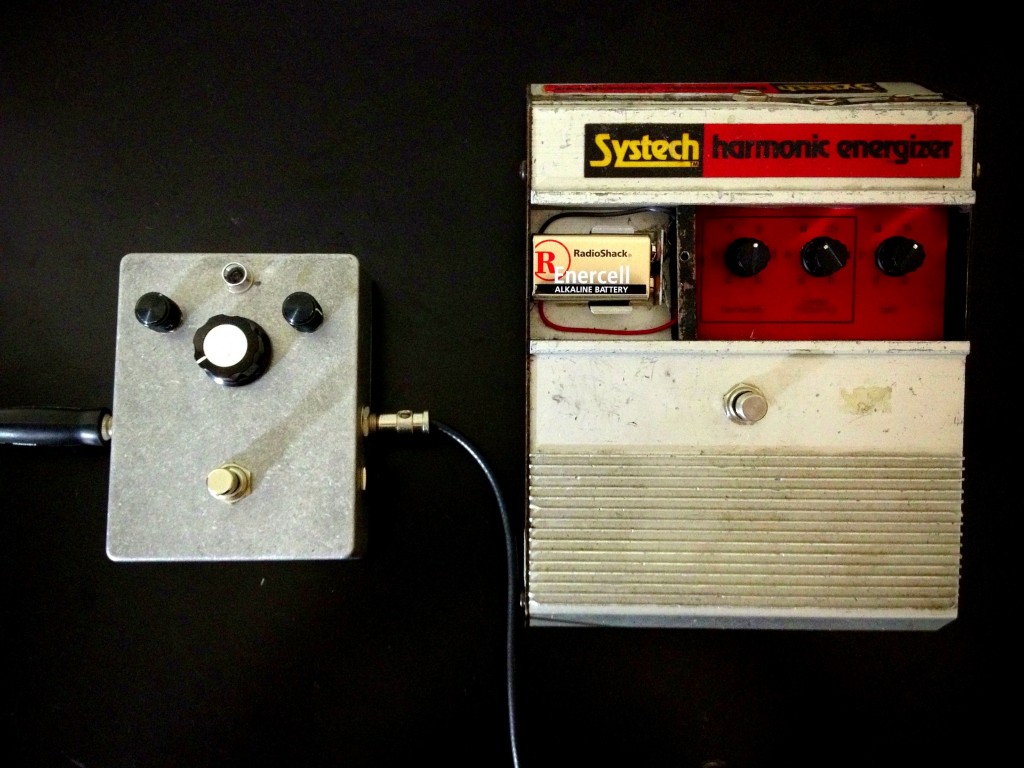
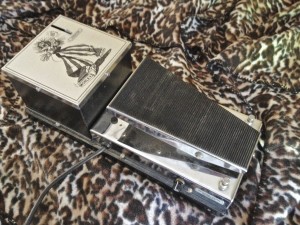
A homely clone cowers in the shadow of a ramshackle original.
Okay, here’s an old weirdo I’ve been meaning to write about for ages. The Systech Harmonic Energizer is an ultra-rare filter/distortion effect from the ’70s that takes the fuzz-wah formula in some interesting directions. Its signature is edgy, ultra-resonant filter sounds. You’re most likely to have heard it generating Frank Zappa’s nasal midrange squawk, but it does lots of other abrasive tricks too. I used this one on Tom Waits’s “All Stripped Down,” and on “Jets” by Action Plus.
The S.H.E. doesn’t do pretty. Most of its sounds are so strongly flavored, they’re hard to use as a primary tones. But it’s great for things like clanky percussive accents, or walloping low-frequency assaults.
We care about the future, because that's where we will be spending the rest of our lived.
“We are all interested in the future, for that is where you and I are going to spend the rest of our lives.” — Criswell, Plan 9 from Outer Space
UPDATE:Wow, I can’t believe all the cool stuff folks have been posting to comments. I find myself feeling quite inspired about the future of instrument — when I’m not laughing so hard I spit coffee all over my laptop. Thanks for all great ideas. Keep ’em coming! 🙂 :thumbup:
Prophecy is for suckers. Who’s stupid enough to go on record with bold prognostications about the future of music and music-making, given the near-certainty that the words will reappear someday to bite you on the ass?
Well, me. And, I hope, you.
So I invite my fellow foolhardy loudmouths to join me in sharing their half-assed guesses wise and well-informed predictions about our brave new fretboard future.
The author of the most compelling prediction wins one of my hand-built stompboxes. So does the author of the one that makes me laugh hardest.
Post your predictions to comments. I’ll go first. 🙂
Hey, I’m totally guilty of fostering simplistic analog vs. digital arguments. After all, I launched this blog over a year ago with an Amps vs. Models listening contest. (The prizes have long since been claimed, but you can still take the test.) But maybe we should spend a little less time arguing about how faithfully that amp model mimics the sound of an amp from 1965, and a little more time exploring the cool and meaningful musical applications of post-analog tone production?
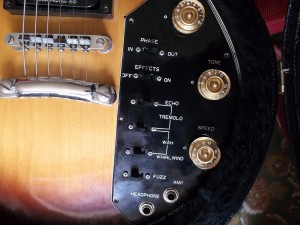
First, he got his hands on a Kay Effector — a psychotronic Korean axe with built-in effects. Then he got it working. Then he recorded a bitchin’ demo. It’s required reading/listening for deviant guitarists.
Two indisputable facts about Leslie rotating speaker cabinets: They sound awesome, and they’re approximately the size and weight of Rhode Island. Since the ’60s manufacturers have attempted to mimic the spinning-speaker effect in a more modest package. And one of the best mimics is the second exhibit in our Museum of Lost Effects.
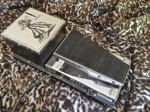
The Morley Rotating Sound Wah is less well known than an earlier pseudo-Leslie, the Univox Uni-Vibe,forever associated with Hendrix. Like the Uni-Vibe, it a) tried to duplicate the Leslie, b) failed, but c) wound up creating a cool tone of its own. But while the Uni-Vibe milks its modulation from a series of optical sensors, the Morley relies on a rotating disc inside a can of electrostatic fluid. The result is a cool and complex modulation sound unlike any other (and one I’ve never been terribly successful at mimicking digitally).
This technology is descended from the “oil can” delays produced in the ’60s by the Los Angeles-based Tel-Ray company.In fact, Morley was a Tel-Ray spinoff — company founders Ray and Marv Lubow chose the name Morley for their line of guitar pedals based on the boast that this relatively compact modulation effect offered “more-lie,” as opposed to “less-lie.” (Note that I said “relatively” compact, since this beast is far and away the heaviest stompbox I’ve ever owned.)
The Morley Rotating Sound Wah is ugly, clunky, and klugey. If you drop it on your foot, you’ll never walk again. But I think it sounds incredibly cool.
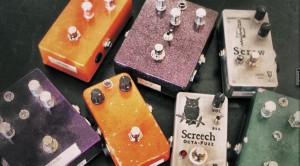
These funky homemade pedals represent all the leading octave-fuzz circuits.
These funky homemade pedals represent all the leading octave-fuzz circuits.
I had no idea I had so many octave fuzz pedals! I had no idea they sounded so different! And after spending way too much time auditioning and recording them, I have no idea when I’m ever going to be able to stand listening to them again!
Naw, just kidding — I had lots of fun putting together this octa-fuzz fest. It features no name-brand pedals, just DIY clones based on old circuits. But hey, most of today’s octave fuzzes are also clones of old circuits.
In fact, imitation has always been the name of the game here. The Roger Mayer Octavia used by Jimi Hendrix was inspired by a circuit found in a British mixing console. The US-made Tycobrahe Octavia was a ripoff of Mayer’s circuit, though tone snobs tend to regard it as the superior unit. It’s certainly one of the rarest and most valuable stompboxes ever. The name “Octavia” has also been slapped on many other variations of the circuit, including some particularly dismal models. The Prescription Electronics Experience and Lovetone Ultimate Octave are based on the Foxx Tone Machine. The Dan Armstrong Green Ringer was based on the Ampeg Scrambler, and I used the Green Ringer circuit as a jumping-off point for some of my own designs. The sincerest form of flattery abounds here.
If you make it through this seven-circuit survey, you’ll encounter most of the major players, and if you hear something that particularly interests you, you can build it yourself using readily available schematics, or buy a nice kit or boutique clone.
Now, don’t confuse this effect with modern digital devices that actually transpose the notes you play. Octave fuzzes use an electronic trick to cancels out much of the fundamental of each note, making the octave overtone stand out more prominently. The process is called full-wave rectification, and ever-knowledgable reader mwseniff explains it far more capably than I in a comment following my previous post on this topic. It’s an odd, glitchy effect that tends to require specific playing techniques for the best results. And for better or worse, it’s an effect that has so far been difficult to mimic digitally. Sure, some of the modeling boxes out there have interesting-sounding octave-fuzz effects, but they tend to score low on the analog-realism scale.
Check out the video. The post-mortem comes after, as post-mortems usually do.
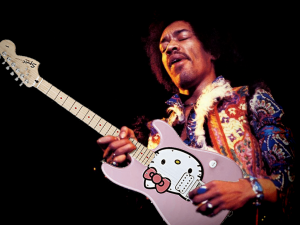
Would this be anything less than awesome? I think not.
Would this be anything less than awesome? I think not.
As I gloated last week, Jane Wiedlin gave me her Hello Kitty Stratocaster — the most bitchin’ $99 guitar ever conceived! I finally had a chance to destroy/customize it yesterday, in what will no doubt be the first of many desecrations/enhancements.
I’d ordered one of those Synyster Gates Duncan Invaders with the pretty white pole pieces for the guitar, but just couldn’t wait to experiment, so I browsed through the ol’ pickup collection, and found a nice Duncan Phat Cat I’d used in a Les Paul experiment some months ago.
I don’t generally recommend choosing pickups because of their names, but come on! Kitty + Cat? How could I resist?
Turns out it was a lucky choice. I hadn’t planned to install a pickup that was actually lower in output than the stock humbucker, but it lets me get nicer clean sounds, and coughs up more than enough crunch when goosed with distortion. Speaking of which: the other custom feature is a built-in-distortion circuit activated via push-pull pot (I took lots of pics of the process for a DIY built-in-effects tutorial I’ll be posting very soon.)
View the carnage in this little video. Thanks, Jane Weidlin! Sorry, Stevie Nicks!
No question about it: Amps are awesome, and guitarists will be plugging into them for a long time to come. But as threatened in this post from last week, I’ve been experimenting with direct- recorded guitar sounds. I’m not talking amp simulators, but the sound of electric guitar recorded straight into a mixing board with no attempt to replicate the tone of an amp. After all, some of the most iconic guitar riffs of all time — including Zep’s “Black Dog,” the Byrds “Mister Tambourine Man,” Chic’s “Le Freak,” and most ’60s Motown hits — were tracked not through amps, but through great old analog preamps, compressors, and mixing boards.
Not that I own any great old ’60s and ’70s analog recording gear. But I wanted to see how close I could get using modern preamps and compressors, plus plug-ins that simulate vintage gear.
And how close did I get? Um…kinda close, and I could have gotten closer if I had an attention span longer than five minutes dedicated sufficient time to the pursuit.
Oh, man — this is the most fun I’ve ever had on this blog (provided you define “fun” as “laughing hard enough to snort coffee through your nose”).
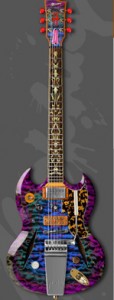
It sucked trying to pick a contest winner! I received over 150 guitar images, and I loved every single one of them (provided you define “love” as “the way you feel about pictures that make coffee come out of your nose”).
I made a little movie featuring several dozen of my favorites. If you’re drinking coffee, cover your nose.
It’s about four minutes long. You can fast-forward to 3:30 if you only want to see my top three picks. I think you’ll agree with me that they are remarkable in their ability to inspire strong emotional reaction, even after viewing so many truly memorable guitar designs. But frankly, I don’t recommend skipping ahead.
I pity the fool who misses out on any of the treasures herein.
Apologies to all whose guitars weren’t included. They were all amazing! And thanks to everyone who made this such a memorable event! Let’s do it again soon.