Categories
DIY guitar

Bigsby + Vibramate + Les Paul

It’s a holiday miracle! The 30-minute Bigsby tremolo installation.

Sometimes it pays to write for a guitar magazine!

My old pal and Premier Guitar colleague Andy Ellis hipped me to the Vibramate, an adapter that allows you to install a Bigsby tremolo on many types of guitars with no drilling or other permanent modifications to your instrument.

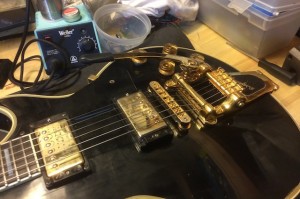
A Bigsby and Vibramate were a centerpiece of a cool makeover project the magazine concocted, transforming a beat-up ’70s Epiphone in a bitchin’ Bigsby-bedecked bombshell. Inspired, I decided to give myself the shakes for Xmas. I bought a Bigsby B7 and corresponding Vibramate kit and popped them onto my long-suffering Les Paul. Check it out:

Yup, this is the much abused ’82 Les Paul that I’ve used in many tonefiend experiments, especially the OCD-approved Pagey Project. What a journey this guitar has been on! Never a big Les Paul fan, I picked up the cheapest old one I could find because I needed it as a reference for the sound design work I was doing for Apple. Trust me — it was a thoroughly unremarkable instrument. But then I started playing with pickups … and alternate wirings … and replacement hardware … and after several years of hacking, I have an instrument I love.

Pity about the gold hardware though — I should have switched to chrome early on. It’s the downside, I suppose, of incremental makeovers. By the time I got to the Bigsby, I had to cough up extra cabbage for the vulgar finish. (My wife recoiled when she saw the Bigsby box on the counter: “Eww — what’s this gold thing?”)
IMG_0361
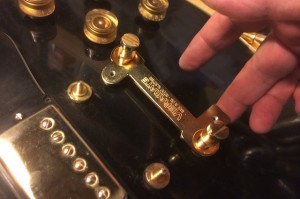
The Vibramate bracket screws into the existing tailpiece bushings.

I’m no Bigsby expert. I’ve never owned a Bigsby-fitted guitar (though I’ve had a couple of long-term loan). It’s odd, because I like how they perform, look, and feel, and “bling cringe” aside, I love it on this guitar. It definitely changes the tone — though in spectacularly unscientific fashion, I replaced the previous roundwound strings with flatwounds while doing the installation, and it’s tricky to sort out which changes are exclusively related to that hardware, and which to the strings. The guitar feels brighter and more resonant. (I’m reminded of Ry Cooder’s dictum: The more springs you add to a guitar, the livelier the acoustic response.) The treble response is WAY different — I needed to lower the treble sides of the pickups to offset the face-slapping response of the high E string.

I’ve bored everyone to tears with my incessant testimonials to the glory of great flatwound strings. This guitar has never worn flats — I’ve kept it in roundwounds for writing product reviews, and for sessions where I specifically need a roundwound sound. But I’m loving the way they sound and feel here, so I guess I’ll have to select another Gibson-flavored guitar as a dedicated roundwound instrument.

The installation was a breeze. The quality of materials is superb. I also added Vibramate’s String Spoiler, a clever little bracket that clips onto the tiny nubbins that usually secure strings to a Bigsby. The Spoiler makes string changes way easier. I’m deeply impressed by the Vibramate products — even in frickin’ gold.

Oh — the demo tune is the late John Barry’s wonderful Midnight Cowboy theme. Berry wasn’t a guitarist, but he contributed so much to the guitar vocabulary through his scores, especially for the early James Bond films. I was privileged to interview Barry for Guitar Player back in the ’90s. What a cool and brilliant musician!
Categories
Pickups Uncategorized

Happy Humbucker-Sized P-90s!

Happy-P-90s

Just in time for the single-coil holiday season: my comparison review of 16 humbucker-sized P-90 pickups is live at Premier Guitar. This heartwarming holiday fun-fest has it all: Mouth-watering adjectives. Freshly baked audio clips. Irate manufacturers. Don’t miss it!

This was a fun, if challenging project. Comparison pickup reviews are such cans of worms! Not only are they sadistically labor-intensive, but the differences between one pickup and the next are easily overshadowed by other variables in the tone chain.

After much thought about how to create meaningful comparisons, we came up with an intriguing process: I tested all the pickups in the same guitar, with identical setups, and ReAmped them through the same combo amps with identical recording settings. If this were an amp or pedal review, I would have used the same performances throughout, but of course, each example had to be played anew with each pickup, so I spent much time matching performances to guard against misleading variations in touch and intensity. It’s not a perfect solution, but better than most, and in the end quite revealing.

And what did it reveal, exactly? You’ll find out at the link. Beyond that, I can report that:

  • All the products sounded pretty good.
  • They sounded more similar than you might expect.
  • I’m gonna find me a guitar to house a set of my favorites — though I’m not sure which ones are my faves! Really, they’re close enough that, say, the tone of a particular body wood alone would be enough to sway the decision. It’s not so much a case of “better or worse” as “brighter or darker” and “louder or quieter.”

As mentioned in the article, there’s no “gold standard” of P-90 tone — or rather, every P-90 lover has his or her own standard. Gibson’s ’50s original are notoriously inconsistent in their output, even their magnet type. Plus, the mere fact that you’re winding coils around a narrow, tall humbucker bobbin rather than a wide, low P-90 one has sonic implications. So I tend to think of this entire pickup category as either “single-coils that are ballsier than Fender single-coils,” or, in the case of hum-canceling models, “humbuckers with brighter highs and clearer mids.” (Or as my ol’ pal Steve Blucher from DiMarzio calls them, “humbuckers that hum.”)

Funny thing: I love P-90s, but don’t own any guitars fitted with them. Not yet. :satansmoking:

So talk to me about P-90s! Your faves? Beloved P-90 guitars? Fave P-90 players and performances?

Categories
Digital guitar Technique

Cue the Drummer Jokes!
Playing Drums with MIDI Guitar

strung_out_121213_small

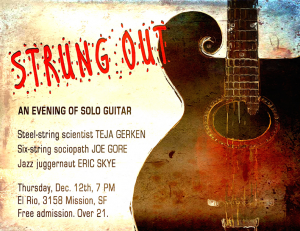
I’m thrilled to bits about a show I’m playing Thursday eve in San Francisco featuring two guitarists of impeccable skill and taste, plus me.

Teja Gerken and I are co-hosting a monthly solo guitar night at El Rio, my groovy neighborhood dive.Our guest is the amazing Eric Skye who, among other things, plays gorgeous solo guitar versions of classic Miles Davis tunes. If you happen to be in cold, cold San Francisco this week, stop by and say hi!

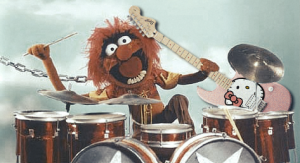
I’ve been doing the digital looping thing with Mental 99 for a few years now, and man, trying to work out solo arrangements with live-looped MIDI drums has been seriously humbling. You know all those jokes we love about how drummers speed up, slow down, drool, and generally disappoint? I can do all those things and everything else a drummer does, except occasionally play a competent groove. Some of the problems have to do with MIDI tracking in general, and some are simply general suckage. Man, it sure makes me appreciate my brilliant musical partner Dawn Richardson, who never speeds up and drools only rarely.

animal_drums

But those who can’t, teach. So I whipped up a little tutorial on playing drums with MIDI guitar. The first half covers the moves, and the second half features a live improv based on my fave afrobeat pattern. (Tony Allen is my rhythm god.) It also includes some of the hybird synth/guitar sounds I’ve been exploring, like double single-not lines an octave lower, mixing trashy guitar and trashy organ, and of course, space pigeons. (I stole the organ line from my pal Robin Balliger.)

In other news: I’ve been speaking to the ultra-knowledgable Rob Hull from Tube Depot about creating a minimalist DIY amp kit inspired by our conversations here. Lots more details to come. Tube Depot has a track record of making real nice amp kits, and Rob’s documentation/build instruction are the best in the biz. I reviewed their cool tweed Champ clone kit here.

Oh — anyone score any good holiday presents yet?

Categories
guitar Music

Getting It Right the First Time

Oh man — I got to open for Television last night in San Francisco, accompanying storyteller Dennis Driscoll. These days the band includes original members Tom Verlaine, Billy Ficca, and Fred Smith, plus Jimmy Rip filling in quite capably for original guitarist Richard Lloyd. They’ve been doing shows where they play their debut album, Marquee Moon, in its entirety (though they mixed and matched songs last night).

Television recorded other cool records, including a lovely 1992 reunion album. But Marquee Moon is one of those instances in which an artist’s aesthetic is etched in stone from the beginning. The two-guitar interplay … the abstract, almost architectural arrangements … the contrasts between stiff and loose time … Verlaine’s free-floating rhythm and quavering 16th-note-triple vibrato—all were present from the get-go 36 frickin’ years ago.

Of course this picture of Television sucks—I took it! L-R: Fred Smith, Billy Ficca, Tom Verlaine, Jimmy Rip.
Of course this picture of Television sucks—I took it! L-R: Fred Smith, Tom Verlaine and Jimmy Rip, with a little bit of Billy Ficca’s hair in the background.

I couldn’t help comparing Television’s artistic arc to that of their contemporaries, Talking Heads. Sure, the latter’s debut, Talking Heads ’77, is a classic, but had the band stopped recording after its release, we’d have only a vague inkling of what the group would become. More than once Jerry Harrison has told me that today’s bands rarely have the luxury of defining themselves over the course of several albums as Talking Heads did, slowly finding their audience and refining their sound. Today’s music business demands spectacular success from the start. A latter-day Talking Heads (if you can imagine such a thing) wouldn’t have the luxury of recording three albums before releasing a bona-fide hit like Remain in Light.

Most great musicians evolve over time—imagine how we’d regard the Beatles, the Stones, Springsteen, Prince, or Dylan if they’d thrown in the towel after one album. That, I think, seems intuitive to most of us. The talent is there—it simply needs time to reach its apogee.

But artists who seem to materialize fully formed mystify and fascinate me. I’m not just talking about Mozart syndrome, prodigies who display phenomenal talent while very young. Mozart grew artistically throughout his brief life. His juvenile works barely hint at the later masterpieces.

On the other hand, consider Charlie Christian, whose style was fully realized from his first recordings with Benny Goodman in 1939, soon after the guitarist’s 23rd birthday. At his initial audition/gig, this kid from Oklahoma was mocked by the Goodman band hipsters for his hick cowboy clothes—until he blew them off the bandstand with 20 consecutive choruses of “Rose Room.” It was the most radical guitar sound the musicians had ever heard. From his first sessions to his last a mere two-and-half years later, Christian’s style never evolved. It was perfect from Day 1.

Dig it! (Charlie’s solo starts at 1:10.)

Another fascinating case: I’ve always had a soft spot for Cheap Trick, though I don’t know their music exhaustively. Like many listeners, I relate more to the relatively raw live versions of their hits on the Budokan album than to the tepid studio originals. The Budokan version of “I Want You to Want Me” has so much more power and passion than the slow, limp, overdub-laden version on In Color. But it wasn’t till 1996’s Sex, America, Cheap Trick compilation that I encountered the original demo of “I Want You to Want Me.” And holy crap—it’s simply one of the most perfect rock and roll tracks ever.

Wow. No overdubs. Monster groove. Fabulous lead vocal. A perfect distillation of Elvis, Chuck Berry, and the Beatles. With all due respect to this long-running and hard-working band, I don’t believe they ever again nailed it quite like this.

Since I’m already probably picking fights, I may as well blurt out that I view the first Doors album and Are You Experienced? in a similar light. Not that Strange Days and Electric Ladyland aren’t great—just that both Hendrix and the Doors entered the public consciousness with their artistry fully formed, and that they never recorded anything that wasn’t implicit in those initial recordings.

Why do some artists just seem to come out of the chute fully mature, while others need time to realize their potential? And which ones would you include on a “Getting It Right the First Time” list?

Categories
DIY Effects guitar

The Lipstick Lab
New Experiments with Old Pickups

Do you ever get an idea that you just know is going to work out brilliantly? And then discover you were totally wrong?

That’s how it was when I finally reassembled my generic Mexican Strat with Duncan lipstick tube pickups. After I recorded a demoing of it here almost two years ago, the guitar lay in pieces alongside my workbench. I’d stare at decapitated body, feeling guilty and dreaming of all the fantastic mods I’d attempt when I finally got around to reanimating it. I had various ideas for the tone control: Maybe a two-band PTB control? Nope—totally underwhelming results. Perhaps a two-in-one TBX? Meh—even less interesting. I drew a blank, and the guitar wound up with a disappointingly normal tone circuit.

But I did discover some cool twists along the way. Details after the video:

My flatwound string addiction is only getting worse, but this is the first time I’ve combined flats and lipstick tubes. (Has anyone done that since the ’50s?) The results were fascinating. As happens when you put flats on an electric 12-string, you encounter a paradoxical increase in highs, despite the darker-toned bass strings. (Maybe it’s because the treble strings ring truer with less phase-canceling interference from roundwound bass strings.) As you can hear, this instrument doesn’t lack for zing.

The opposite, actually — treble notes explode from the instrument, often more than you’d like. I experimented with various action and pickup height adjustments, but no matter how I set things, it was difficult preventing certain notes from shrieking. The only solution was to play the damn guitar for a few hours and grow accustomed to the touch.

Categories
Acoustic guitar Pickups

A Lo-Fi Acoustic Guitar Pickup

Part acoustic, part electric—but 100% bitchin'.
Part acoustic, part electric—but 100% bitchin’.

This post is inspired by in interview I just did with Mississippi Allstars guitarist Luther Dickinson, a cool dude and a deep player. I’m digging the band’s new album, World Boogie is Coming. (And for better or worse, that praise comes from someone who hates almost all modern blues albums.) You can read the interview here.

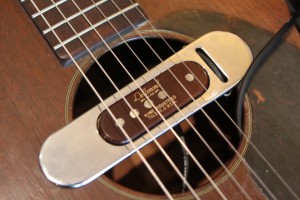
Anyway, Luther was talking about how his entire style is a quest to create a loud, electric version of acoustic country blues. He mentioned how he was more drawn to the Mississippi blues players who went electric by slapping DeArmond pickups on their acoustics, as opposed to, say, Muddy Waters, who swapped his acoustic for a Telecaster. Luther also mentioned that DeArmonds are still his favorite way to amplify an acoustic guitar

At some point it occurred to me that I’d never actually played an acoustic with a DeArmand. So I picked up a 1950s RHC-B and popped it into my old Martin 0-18. Have a listen:

I’m a longtime fan of magnetic pickups on acoustic guitars. I had a Sunrise in my Lowden for 15 years and loved it, but it croaked last year. I replaced it with one of those hybrid models that combine a mag pickup with an internal mic, and it works fine. But after a year or so, I don’t think I’ve ever used the mic sound. I just like the way the mag pickup sounds.

But is it still acoustic guitar? I’m not sure. I increasingly view amplified acoustic as a guitar category unto itself, residing somewhere between acoustic and archtop.

And the DeArmond? Between its noisiness and reticent highs, it’s probably not the best choice for every occasion. It’s also a bigger pain to install and remove than modern mag pickups. But I dig how it sound in the video, and I’m definitely keeping it!

So what’s you experience with amplifying your acoustic guitars?

Categories
DIY guitar

The Fender TBX:
A Cool 2-Band Tone Control

You can TELL it's Photoshopped! There's no TBX!
You can TELL it’s Photoshopped! There’s no TBX!

Thanks again to everyone who chimed in on the “What your favorite mod?” discussion. I got tons of great ideas from your comments.

Like this one, which I’ve been meaning to explore for ages: the Fender TBX tone control circuit, which appears in several Custom Shop instruments, notably the Clapton signature Strats. Like the G&L PTB circuit I’m so apeshit about, it’s a 2-band passive tone control — but one that sounds very different.

The PTB is a two-knob circuit that lets you siphon off highs, lows, or both. I’m agog at how well it works with humbuckers — you can get so many cool sounds by rolling off lows on the way to a fuzz, as heard here.

But TBX (it stand for “treble bass expander”) is a one-knob circuit, tbough that single knob rotates two stacked pots. The control has a center detente. Set here, it’s like a regular tone control, wide-open. Turn it counter-clockwise and highs vanish, per usual. (You could “tune” the roll-off frequency with various capacitors, though I went with the stock .022uF.) But when you rotate clockwise, the absence of lows makes glassy highs erupt.

The dual pot cut highs or lows.

Technically, it’s not a boost, but it sure feels like one. Dirk Wacker, my now-colleague at Premier Guitar, dissects the circuit far more capably than I can here. (And he goes way beyond in this subsequent article on TBX mods. Man, I have some catching up to do!) He makes a good case for replacing the stock resistor with another value, but I went with the original 82K to establish a point of reference. I’ll try his mod when I restring, and I’ll update you here.)

BTW, you need the Fender TBX kit for this project — it uses highly customized pots to work its magic, and a standard stacked pot won’t do. But it’s cheap: You can find the TBX kit, with the pot, hardware, and passive components, online for about $15.

I put it into the mongrel strat I’ve been using as my digital synth/looping guitar. I’d been using a Stellartone Tone Styler, a cool Vari-Tone variant that switches between multiple capacitors. I dig it, but it’s the old model which clicks, rather than fades, from setting to setting, and it requires a powerful twist of the wrist to go from maximum to minumum, which I do every time I grab an EBow. Since I hadn’t gotten around to replacing it with the smooth-action version, I figured I’d try the TBX.

And I’m glad I did. It’s a super-easy install, at least to the extent that any job that requires removing both strings and pickguard can be easy.And here’s how it sounds:

I’m going to keep this one around for awhile. You’re hearing it through an analog rig, obviously, but I want to find out whether that extra shot of highs does anything meaningful when playing digitally. I’d also like to experiment with different cap and resistor values.

And now I can’t help wondering whether this would sound cool with humbuckers. Anyone have any experience with that?

Categories
DIY guitar

What’s Your Favorite Mod? (Here’s Mine.)

How am me make guitar thing better?

What’s your favorite guitar mod? The kind that changes how you play. One you’ve become so accustomed to that you wince when you pick up an axe that lacks it?

I’ll choose pickup wiring mods as a starting point: During the year that Seymour Duncan sponsored tonefiend.com, I devoted many posts to the under-appreciated wiring schemes I found in the company’s wiring diagram database. Some faves:

…and of course, the suicidal soldering mission known as the Pagey Project.

I’ve still got the “advanced” version of the Pagey wiring in my nothing-special beater Les Paul, and I like it so much, I want to fix up the guitar so it feels as nice as it sounds.

But of all the wiring experiments I tried, my absolute favorite is one that doesn’t appear in the Duncan archives: the so-called “PTB” tone control (for “passive treble and bass”). It’s a cliché to call a neglected idea “ahead of its time,” but in this case, it happens to be true. Being able to roll off lows as well as highs is unbelievably useful when sculpting sounds. It makes me want to run into the nearest Bain Capital Guitar Center, grab players by the collar, and shout, “You need to know about this!” (But I probably won’t, ’cause G.C. customers aren’t accustomed to receiving that sort of personal attention, and I wouldn’t want to freak them out.)

Allow me to repost last year’s video, demonstrating the circuit in action:

Over a year later, I remain totally addicted to this circuit, and I recommend it to anyone who doesn’t require a guitar with independent volume controls per pickup. (Everyone, basically.) It seems especially relevant for drop-tuned and 7-string metal players who realize you must sometimes cut a little bass to keep the lowest register tight and articulate. And the circuit is a godsend when used with bass-heavy fuzz pedals (such as vintage-style Fuzz Faces). In fact, I’ve even been building the circuit into the front end of certain loud fuzz pedals for use with guitars lacking this magnificent mod.

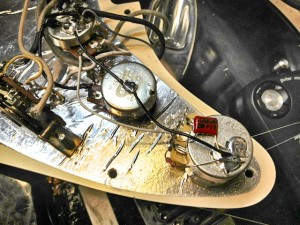
But I remembered something interesting this week when I opened up the Hamer 20th Anniversary guitar used in the video:

Categories
DIY Effects guitar

It’s Raining Germanium!

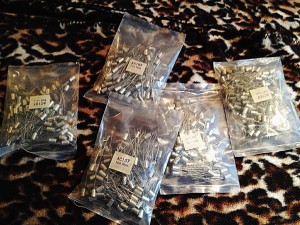
I just bought 500 germanium transistors. Yes, as a matter of fact, I am insane. Why do you ask?
I just bought 500 germanium transistors.
(Yes, as a matter of fact, I am insane. Why do you ask?)

UPDATE: My Dunlop Fuzz Face Mini review is live at Premier Guitar. Audio clips included!

How and when did it get so frickin’ easy to procure great-sounding germanium transistors?

I’ve been building stompboxes for four years or so. I used to consume article after article detailing the sheer horror of dealing with germanium. Sure, those old-school transistors sound great, I’d read, and they’re necessary for vintage distortion circuits. But they’re unstable. They’re expensive. They’re hard to find. You have to sort through dozens to find the few good ones. And once you do, you must spend countless hours matching and biasing them for optimal sound.

I believed everything I read — until I finally admitted to myself that I seldom encountered any of those problems.

(If you don’t know much about germanium transistors and why they’re cool, here’s my manifesto.)

I used to buy germanium transistors from Small Bear and other parts sites, and was always happy with the results, even though I had to pay eight or ten bucks per transistor. (Small Bear even does the matching for you, offering sets of transistors suitable for various vintage fuzz circuits.) However, it was a little tough finding NPN (negative-ground) germanium transistors. In fact, Small Bear once rejected my order of a dozen or so NPNs because they were so scarce. (To his credit, Small Bear’s Steve Daniels explained that he restricted sales so that everyone who wanted to build a couple of great DIY fuzzes would have the opportunity.)

The workaround is to build pesky positive-ground pedals, or jigger with the schematic in order to use PNP (positive-ground) transistors in negative-ground circuits. (This site’s Fiendmaster project is an example of the latter workaround.)

Then some odd things happened:

Categories
Digital Recording

Logic Pro X:
What’s New for Guitarists & Bassists?

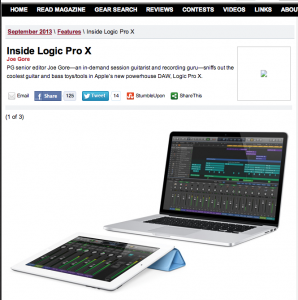
Inside Logic Pro XAs promised: an overview of Apple’s new Logic X Pro, with an emphasis on what’s new and cool for guitarists and bassists. Lots of movies and audio!

It’s here.

This is an exciting post for me, and not just because I get a desperately needed break from Klons and Screamers. I’m thrilled to bits about Logic Pro X and MainStage 3, though I’m still wrapping me head around them. (Yeah, I worked as a developer for both products, but I didn’t get a proper program-wide view until last week’s release.)

Also, it’s my first story for Premier Guitar, whose staff I’ve just joined as a senior editor. I’m stoked because it reunites me with PG editor Shawn Hammond and senior editor Andy Ellis, both of whom I remember fondly from my Guitar Player magazine days.

There’s much talent and coolness on the staff. I’m a happy little guitar nerd. Plus, the schedule is loose enough that I can still record, perform, and continue to work with audio/software clients.

What does the gig mean for this blog? Good things. I have no plans for a major course change — there are too many things I can only cover on a non-commercial site, including some of the topics closest to my heart. Meanwhile, working with PG will keep me more up-to-date on new music, new gear, and scurrilous guitar community gossip. In some cases, though, I may link to a PG article I’ve written rather than duplicate the work here. Today, for example. 🙂