The gold medalist is wrangle, for his touching coming-of-age tale about the day he learned there’s a reason musicians say “One two three four” before they start playing. Tied for second: Mark Spangler’s harrowing near-death experience as Jeff Beck’s hand-picked opening act, and Roel Torres’s terrifying tale of being hoisted skyward by stage machinery. (Think twice before wearing a hoodie onstage, kids!) Both are worthy of reenactment on one of my fave guilty-pleasure TV shows, I Shouldn’t Be Alive.
Winners, send me your snail mail addresses, and I’ll send you something noisy.
Thanks to everyone who submitted a story, voted in the poll, or just read the stories and spewed coffee on their computers. Thanks for holding court while I was traveling, and for giving me plenty of good laughs on the road. In the meantime, I’ve pretty much gotten over jetlag, flu, and a mountain of postponed paying work, and I’ve got some cool and intriguing posts planned for the coming days!
You can read all the entires here. Or just the finalists here. Or just the winners after the jump.
I was just in Europe, but I’m heading right back — this time on vacation. We’re going to spend a few days knocking around some fave cities, then embark on a tour of Paleolithic cave painting sites in France and Spain.
Our Cro-Magnon ancestors had to contend with such hardships as poor stage lighting, inadequate sound reinforcement, and excessively reflective surfaces.
I know it’s hard to tell when I’m being sarcastic, but this time I’m not. I wanted to be an archaeologist as a kid, until my mom said, “Why? All you’ll do is sit in a closet polishing worthless scraps with a toothbrush.” (Fortunately, she was more supportive of my musical dreams. She never said, “Why do you want to be a studio musician? All you’ll do is sit in a closet polishing worthless scraps with Pro Tools.”)
Since I won’t be able to post and reply as often as usual until I return at the end of the month, I figured you guys could help me keep things interesting. Which brings me to the latest tonefiend contest: the Cro-Mag Comedy Competition!
The rules are simple, just like the musicians we’ll be poking fun at. All you must do to enter is post a funny musical anecdote to the comments section below. It doesn’t have to be about musical stupidity, though experience suggests that those are the funniest stories. Nor does it have to be about guitar, though there are few things stupider than stupid guitarist stories. (Drummer, bassist, and vocalist stories are the obvious exceptions.) The tales should be true, or at least sufficiently true-sounding to dupe the rest of us. If they involve real people, please change their names enough to avoid legal action.
I’ll winnow down the entires to a manageable number via some as-yet-undertermined means (dartboard, or maybe animal entrails), and you, dear readers, will get to select the final three winners, each of whom will receive one of my unique handmade stompboxes, created in a closet at my cutting-edge workbench out of worthless scraps premium mojo parts.
Enter as many times as you like — but please, only one anecdote per comment. Also, please post your anecdotes here on the site, rather than in Facebook comments. Stories can be as long as you like, but remember: Your judges will be musicians, so they may have difficulty grappling with complex sentences.
The contest runs till I get back, or till jet lag subsides — whichever comes last.
Here’s a sample story to get the ball rolling. Naturally, I’m ineligible for the competition because I already have enough crappy little pedals it’s the ethical thing to do.
I heard this one from one of my favorite guitar techs. He’s such a pro that he refused to reveal the identity of the musicians in question, though I managed to pry from him the fact that it’s a leading UK or Irish band you’ve probably heard of.
Anyway, the band’s bass player insisted on using a large, loud, miked amp onstage, even though the front of house guy used only the direct signal in the PA. “Please don’t use an amp,” the crew and band pleaded. “It leaks into the other mics. It screws up everyone’s onstage mix. It makes everyone’s life more difficult. You can have as much bass in your wedges as you like. Or wear-in-ear monitors. Or anything! But please, no amp!”
“Sorry,” said the bassist. “It’s my sound. What’s more, I refuse to step foot onstage tonight unless I see my amp up there with a mic on it!”
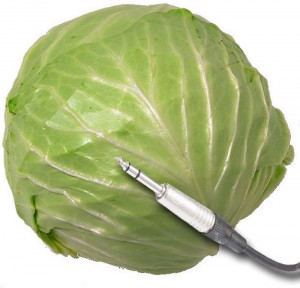
That night the amp was right where the bassist expected it, with the usual mic in the usual place. But unbeknownst to the bassist, the mic cable wasn’t connected to the sound system. The cable ran offstage, where it was plugged into … a cabbage, pilfered from catering.
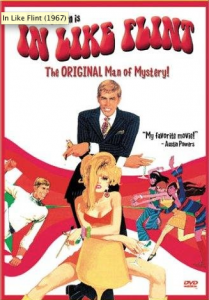
I just recorded a solo version of one of my fave film themes: Jerry Goldsmith’s main title to the 1967 spy spoof In Like Flint. I’ve adored the melody since childhood, and I blame it for instilling the love of chromaticism that made possible my extraordinarily uncommercial career.
I’d previously posted another version of this tune, performed upside-down on a friend’s lefty guitar. But that was all-analog — this time it’s digital. And I’ve used the video to highlight a favorite MIDI technique: doubling recognizable guitar sounds with non-guitar synths and samples.
I’ve been obsessed with this score since dinosaurs ruled the earth.
It’s funny — being able to trigger pretty much any sound from the guitar isn’t necessarily as liberating as you might think. Sure, when you first try it out, it’s thrilling to conjure an electric piano sound from the fretboard. But who wants to hear some schmo noodle aimlessly on electric piano when they could be noodling aimlessly on guitar?
For better or worse, I find myself using this technique repeatedly. When I double a part effectively, the result still seems like part of the guitar cosmos. It feels like expanding the palette, as opposed to vomiting on it. (Not that I’d be above vomiting on a palette if it helped create a cool painting.)
Did anyone else encounter this sort of childhood musical contamination? A melody, progression, or tone that infected you early on, and colored everything after? I’m not talking image, like falling in love with the Beatles on Ed Sullivan or Nickelback on the CBC because they were so frickin’ cool. I mean a primal sonic imprint. Anyone?
No longer ridiculously expensive. Now they’re just very expensive.
I spent last week covering the Musikmesse musical instrument trade show in Frankfurt, Germany, for Premier Guitar. I had a blast, and Chris Kies and I posted details and pics of more than 70 new products. (Here’s the short list of our personal faves.) Kies shot lots of video, and will be posting more than 50 demo segments to the PG site in the coming weeks.
But Messe is hellishly loud, far noisier than NAMM. When I finally got home and picked up a guitar, it was an acoustic. I was trying something new, based on info I obtained from Mary Faith Rhoads-Lewis, CEO of Breezy Ridge, a company that distributes several brands for acoustic musicians, including John Pearse strings.
I’d previously geeked out here about about the strangest and most expensive guitar strings I’d ever tried: this “rope core” set from Austria’s Thomastik-Infeld. Reader/cool guy Al Milburn turned me on to them, and I wrote about them here. And I recently posted this video demonstrating how the transformed my old Martin 0-17 into a compelling steel/nylon hybrid with a unique and expressive voice.
Anyway, Ms. Rhoads-Lewis told me that the late John Pearse originally created this set for Thomastik, and that the John Pearse Folk Fingerpicking set [PJ116] is identical to what the Austrian company sells. Best part: You can get them in the States for under $20, as opposed to a walloping $35 for the Thomastiks. She also told me that their magic works in reverse: You can put this relatively low-tension set on a classical guitar for a very different sort of hybrid steel-string sound. (This, she said, is exactly what the great Brazilian player Bola Sete used to do.)
I popped a set on my old Yairi classical. The feel was — totally strange, and in precisely the opposite way as on the Martin. The tone was edgy and exciting, but the tension seemed a little too extreme. If just seemed a little too … high-strung, in every sense. Then I tried lowering the entire tuning a whole step, with the sixth dropped all the way to C.
And … oh, my. Check it out:
Summary: Holy cannoli, I love how this sounds. And there’s something psychologically satisfying about the transformation too. See, this guitar has always been a bit … tragic to me. I got it when I was 16. My classical guitar prof at UCLA said I needed a better instrument, and my every-supportive folks, bless ’em, helped me buy this Alvarez Yairi for around $700 (in 1970s dollars). It was a top-tier model for Alvarez, signed by luthier Kazuo Yairi, and boasting lovely Brazilian rosewood backs and sides. It was a huge upgrade for me, but as I got deeper into classical playing, its shortcomings emerged. Had I not shifted my studies to composition, I’d have needed to upgrade again. I envied the Igancio Fleta y Hijos models my two teachers played, but at around $3,000, they were beyond my budget, even with parental help. (Pity — their current value is approaching $50,000.) So I’ve used this instrument as a limited but decent-sounding model suitable for pop work, if not serious classical concertizing.
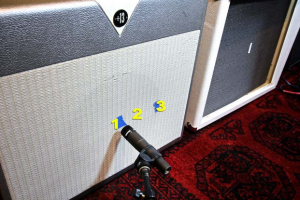
May I take this opportunity to pimp my new monthly recording column in Premier Guitar? The first installment covers basic electric guitar miking technique. It’s ground that’s been covered often enough before, though I hope the article’s many audio files (recorded via ReAmp, moving the mic between “takes”) shed some new light on the topic.
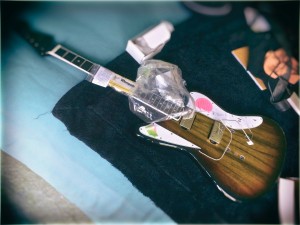
Meanwhile, I’m breathlessly stoked about my new “Partsmaster.” It’s a Korina “Split Jazzmaster” body from Warmoth with Fralin P-92s and some new tricks I’ve been wanting to try with wiring and onboard overdrive, plus several other ill-considered, stab-in-the-dark adventurous experiments. It’s like some wacky Firebird/Jazzmaster hybrid (“Birdmaster?”) I hope to post some video later this week, but right now, the guitar is awaiting the plek treatment at Gary Brawer’s shop. Gary is also prettying up some of my clever but sloppy wiring, and remedying the fact that, when I brought the beast in, the strings were about a half-inch from the fretboard.
I just received from Warmoth all the parts for my next DIY guitar. I loved testing eight sets of P-90 pickups for Premier Guitar, but I don’t own any P-90-eqipped guitars.I will soon, though!
This one will be a bit of a platypus — as opposed to, you know, all my other other platypi. (The actual plural of “platypus” is “platypuses,” but “platypi” is more fun to type.) It’s built from Warmoth’s “split Jazzmaster” template, with a korina body, bound neck, Tune-o-matic/stop-tailpiece bridge, and a pair of hum-cancelling Fralin P-92s. Yeah, it’s kind of a stab-in-the-dark experiment, and not a inexpensive one. But hope springs eternal. Prepare to be bored with details!
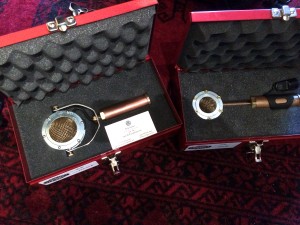
I’ve also just received an amazing-looking pair of condenser mics from Portland, Oregon’s Ear Trumpet Labs. ETL kingpin Philip Graham’s business card identifies him as “proprietor and bricoleur.” Bricolage, of course, is the ten-dollar word for “making stuff out of junk and other found objects.” Dig the steampunk vibe of that repurposed hardware! I haven’t even plugged these in yet (though the reviews I’ve read have been stellar). I just like staring at them! But I’m going to try them out at my monthly Strung Out! show tonight.
Ear Trumpet Labs’ Edwina and Edna models: a higher calling for found objects!
Which brings me another of this week’s highlights: I got to perform last night with my dear friends Teja Gerken and Adam Levy. Teja is an astonishing acoustic fingerstylist and a fine composer. His vocabulary has hints of Bensusan, Hedges, and classical, but he’s molded those influences into a thoroughly unique sound. And Adam, who I’ve known since my Guitar Player magazine days, is equally renowned for his jazz work and for accompanying such singer/songwriters as Norah Jones and Tracy Chapman. (I get to play some of Adam’s cool parts when I gig with Tracy.) These days Adam’s focusing on songwriting, and he his sings his “smart Americana” songs (my description, not Adam’s) in a sweet, soulful voice. Man, what a treat to hear both of them up close. And tonight, Adam, Shelley Doty, and I perform at my local dive, El Rio. Can life get any better?
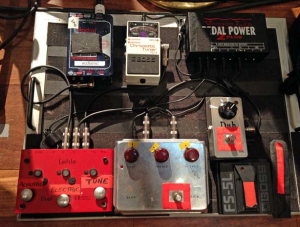
Apparently so! Yesterday Premier Guitar posted John Bohlinger’s piece on the Pixies, which includes a pic of Charles “Frank Black/Black Francis” Thompson’s pedalboard, with my grubby, hand-built Duh fuzz pedal front and center. I’d originally made if for Joey Santiago, the other Pixies guitarist, but I guess Charles swiped it. Hey, I’d be honored if either guy spat on the thing! They’ve been heroes since I first heard the band in a small San Francisco club back in ’88. (Everyone went to hear the Sugarcubes, but left talking about that awesome opening act from Boston.)
Frank Black’s pedalboard: Lookit! I’m Pixies-approved!
It’s funny, because I really was thinking “Pixies” when I sound-designed the Duh. I was going for “bubblegum metal” — a thick, heavy sound, but not a macho one. The tone is too fizzy and funny for 100% sincere heavy rock, IMHO. It’s more of a “greasy kid stuff” distortion. (Note to readers under 45: That was once the tagline for a “dry look” mens hair product, referring to the outdated coiffures that would return with a vengeance when punk broke a few years later.) It’s a vaguely Muff-like sound, but with less compression, less scoop, and one big, stupid knob. I also like building that circuit into guitars. Like this one:
So it’s been a grand week, but a hectic one. Thanks for reading this far. Next week I promise a proper post, and not another collection of … odds & ends.
One of the coolest gizmos from last weeks NAMM show is already in my grubby little hands: It’s the Logidy EPSi, the first customizable convolution reverb pedal. I ordered it the instant I heard about it, and it arrived right before I left for Anaheim.
Convolution (or impulse response) reverbs can mimic acoustic spaces and outboard gear with astonishing accuracy. (If this concept is new to you, check out this article by me. Or better yet, this one written by someone who knows what he’s talking about.) Nutshell: You create impulse response (IR) files by playing and recording a test tone in rooms or through gear. Once you load the file into an IR reverb device or plug-in, it can make anything sound as if it was recorded with the same ambience.You can also generate eerie, otherworldly sounds by loading unusual audio files.
Many software and hardware amp and effect modellers use IRs to mimic gear. Software convolution reverb plug-ins such as Audio Ease’s Altiverb, Logic Pro’s Space Designer, and Waves IR1 include reverb libraries, and also let you load your own IRs. But as far as I know, EPSi us the first device that lets you load your IRs into a stompbox and access them without playing through a computer.
I’m psyched to add IR reverbs to my (mostly) analog pedalboard, and EPSi makes it relatively easy to load the IR libraries I’ve compiled. The files require special treatment: They must be 44.1kHz WAVs, and the names must be formatted quite specifically, as detailed in Logidy’s documentation. The interface is extremely minimal: just a bypass footswitch and a knob/button pair to navigate the simple menus.
This unique reverb stompbox sounds great and offers limitless opportunities for creative sound design. You can load your own impulses, or add ones from from some of the fine freeware libraries online. (Thanks for the link, Scott!) On the downside, it’s difficult to load or edit sounds on the fly, so while it might be fun to spelunk for new sounds in the studio with EPSi, don’t plan on modifying sounds onstage. (The ability to recall several saved presets would vastly improve EPSi as a gigging tool.)
BBC dumbaas: "What are you going to do when you leave school? Take up skiffle?"
Aha! Now we know why no one has developed a cancer cure! It’s because young James Page took that skiffle thing a little too seriously.
Yep — it’s Jimmy Page at 13 in 1957. (He turned 70 this week.) Imagine how different the world would be had he followed his stated goal of becoming a cancer researcher. We’d probably have eliminated cancer 30 years ago, but our music would be a lot crappier.
As much as I love Pagey’s playing, I’ve long felt his greatest influence was as a producer. He defined what rock sounds like, largely via his unprecedented innovations in exploiting and manipulating reverberant spaces. Zep sounds like modern rock. Nothing before does.
Condescending BBC presenter: “What are you going to do when you leave school? Take up skiffle?”
Many years ago I was kicking that notion around with my friend Andrew Goodwin, the brilliant British media studies scholar. He expanded our ramblings into a journal paper, and gave me an entirely undeserved co-author credit. To this day, it’s my only academic publication. Andrew went on to create a Led Zeppelin course at the University of San Francisco. He was working on a Zep book when he died in a freak apartment fire a few month ago. I assume he was aware of this clip, though I’m not certain. He definitely would have loved it! I miss him.
What’s your favorite Pagey moment? I think mine is from one of those leaked studio outtakes, an excerpt from “Heartbreaker.” You hear the amp close-miked and claustrophobic-sounding. Then you hear it miked from a distance, spooky and reverberant. Then you hear both sounds together. Voilà — modern rock guitar.
My fave Pagey solo is — hehe — “Sympathy for the Devil.” Yeah — I still think he played that one.
Earlier this year I got to do a couple of shows with Marianne Faithfull, who prompted the song in the first place when she gave Mick a copy of Bulgalkov’s brilliant novel The Master and Margarita. We were talking about the song, so I figured it was my moment to finally solve the mystery.
“So who played the solo?” I asked.
She rolled her eyes and sighed. “I just knew you were going to ask me something idiotic like that.”
But not everyone is a resolution cynic. Check out the comments section below last year’s NYE post, and you’ll find a dozen entires from Josh Starmer, who pledged a year ago today to record an entire album, finishing one song per month.
Yup — he did it! You can read about his journey here.
Speaking of journeys: I emailed Josh to congratulate him, and he wrote back from frickin’ Cambodia on the day he was touring Angkor Wat.
Heck of a year, Josh!
I solicited words of wisdom. Josh’s reply:
For every one part challenging, it was 10 parts rewarding. Before I started, I’d never written a song before. I’d recorded little instrumental tunes, but nothing with words. I was pretty intimidated by lyrics early on, so I did what any awkward person would in such a circumstance, I sang about the weather. I then sent the song out to my closest friends and, over the months, their praise and complements kept me going, and their honest criticisms made me better. I’ll have an album out by mid-February.
Each month started out with one or two weeks of doubt and freak out. It didn’t matter how good an idea I had about what I wanted to record, it always seemed impossible. But, like everything, it was just a matter of starting, pressing record, and then putting the song together, piece by piece. The second two weeks of each month were always filled with immense pride as I watch the song materialize out of nothing. An idea in my head made real, and in many cases, better.
Along the way I developed a systematic method for singing in tune (which, sadly, is a different skill from playing any other instrument in tune), and I’m going to write about that as soon as I can. There’s a lot of bad advice out there on the internet, and I think what I came up with works really well.
Oh, and perhaps the most important thing – I can’t say enough about how cool it’s been to take an seemingly impossible task and just chip away at it each month in a disciplined way. I’ve found myself encouraging everyone I meet to do a similar thing – be it sewing a quilt, or writing short stories, etc…
How cool is that?
Anyone up for the “Starmer Challenge” in 2014? Or are you goals more modest? Or more grandiose? Please — confide your hopes and dreams for 2014 so that one year from today we can all join together to laugh at your failure toast your amazing accomplishments!
So what are my 2014 resolutions? Easy — same as 2013! :satansmoking:
Somewhere far, far away, all NYE resolutions come true.
It’s a holiday miracle! The 30-minute Bigsby tremolo installation.
Sometimes it pays to write for a guitar magazine!
My old pal and Premier Guitar colleague Andy Ellis hipped me to the Vibramate, an adapter that allows you to install a Bigsby tremolo on many types of guitars with no drilling or other permanent modifications to your instrument.
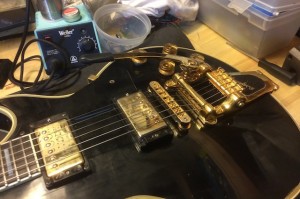
A Bigsby and Vibramate were a centerpiece of a cool makeover project the magazine concocted, transforming a beat-up ’70s Epiphone in a bitchin’ Bigsby-bedecked bombshell. Inspired, I decided to give myself the shakes for Xmas. I bought a Bigsby B7 and corresponding Vibramate kit and popped them onto my long-suffering Les Paul. Check it out:
Yup, this is the much abused ’82 Les Paul that I’ve used in many tonefiend experiments, especially the OCD-approved Pagey Project. What a journey this guitar has been on! Never a big Les Paul fan, I picked up the cheapest old one I could find because I needed it as a reference for the sound design work I was doing for Apple. Trust me — it was a thoroughly unremarkable instrument. But then I started playing with pickups … and alternate wirings … and replacement hardware … and after several years of hacking, I have an instrument I love.
Pity about the gold hardware though — I should have switched to chrome early on. It’s the downside, I suppose, of incremental makeovers. By the time I got to the Bigsby, I had to cough up extra cabbage for the vulgar finish. (My wife recoiled when she saw the Bigsby box on the counter: “Eww — what’s this gold thing?”)
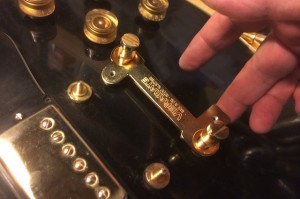
The Vibramate bracket screws into the existing tailpiece bushings.
I’m no Bigsby expert. I’ve never owned a Bigsby-fitted guitar (though I’ve had a couple of long-term loan). It’s odd, because I like how they perform, look, and feel, and “bling cringe” aside, I love it on this guitar. It definitely changes the tone — though in spectacularly unscientific fashion, I replaced the previous roundwound strings with flatwounds while doing the installation, and it’s tricky to sort out which changes are exclusively related to that hardware, and which to the strings. The guitar feels brighter and more resonant. (I’m reminded of Ry Cooder’s dictum: The more springs you add to a guitar, the livelier the acoustic response.) The treble response is WAY different — I needed to lower the treble sides of the pickups to offset the face-slapping response of the high E string.
I’ve bored everyone to tears with my incessant testimonials to the glory of great flatwound strings. This guitar has never worn flats — I’ve kept it in roundwounds for writing product reviews, and for sessions where I specifically need a roundwound sound. But I’m loving the way they sound and feel here, so I guess I’ll have to select another Gibson-flavored guitar as a dedicated roundwound instrument.
The installation was a breeze. The quality of materials is superb. I also added Vibramate’s String Spoiler, a clever little bracket that clips onto the tiny nubbins that usually secure strings to a Bigsby. The Spoiler makes string changes way easier. I’m deeply impressed by the Vibramate products — even in frickin’ gold.
Oh — the demo tune is the late John Barry’s wonderful Midnight Cowboy theme. Berry wasn’t a guitarist, but he contributed so much to the guitar vocabulary through his scores, especially for the early James Bond films. I was privileged to interview Barry for Guitar Player back in the ’90s. What a cool and brilliant musician!