Categories
Effects guitar Music Recording Technique

The WRONG Way to Use a Talk Box

Any talk box fans out there?

Whew. Didn’t think so. I mean, doesn’t everybody hate those godforsaken things? Wasn’t it all downhill after “Tell Me Something Good?”

But did you know that the “talking guitar” has a rather exalted history four decades pre-Frampton Comes Alive? Check out this performance by Alvino Rey, the steel guitar genius who pioneered the technique.

I am TOTALLY going to have nightmares about Stringy for the next 10 years!

Rey worked his magic in tandem with his vocalist wife. She supposedly stood behind a curtain with a mic attached to her throat, the output of which modulated the guitar signal. (That’s what online sources say, though it sounds a bit fishy to me.) A similar technique β€” or perhaps the same one β€” was known as the Solovox. In this case, a small loudspeaker attached to the singer’s throat, “playing” the music through the vocalist’s mouth. More amazing/horrifying evidence:

That’s the basic principle behind the rock-era talk boxes, though they rely on a plastic tube inserted into the mouth rather than a mic pressed to the neck. The first commercially available model was Kustom’s The Bag from 1969, “immortalized” on Steppenwolf Live. The Heil Talk Box β€” the version of the effect most of us know and loath β€” debuted in 1973. Dunlop is still making them.

But I have a perverse affection for the Rocktron Banshee. It’s incredibly loud. It’s actually a small amp, quite capable of driving a speaker cab, with a blunt-force distortion tone. That extra power is useful for my preferred way of using a Talk Box:

How about you guys? Anyone have anything good to say about the talk box?

Heil_TalkBox_1974

Categories
Effects guitar Recording

Klon vs. Screamer Test:
The Results Are In!

As promised, the correct answers to the Klon vs. Screamer blind listening test posted exactly a week ago:

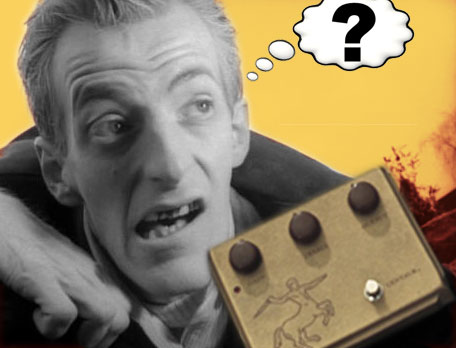
klon_zombie

Example 1: medium gain, medium tone

Pedal A = BYOC clone
Pedal B = Klon Centaur

Example 2: high gain, medium tone

Pedal A = BYOC clone
Pedal B = Klon Centaur

Example 3: low gain, medium tone

Pedal A = Klon Centaur
Pedal B = BYOC clone

Example 4: medium gain, bright tone

Pedal A = Klon Centaur
Pedal B = BYOC clone

Example 5: medium gain, dark tone

Pedal A = Klon Centaur
Pedal B =BYOC clone

And the winners are…

Categories
Bass Digital Effects guitar Recording

Logic X is Here!

Nnnggg...pedals.
Nnnggg…pedals.

Apple released the long-awaited Logic X a few minutes ago. And it’s dripping with cool new guitar and bass stuff: a fabulous bass amp modeler. Lots of new virtual stompboxes. Vast new libraries of guitar tones, and newer, smarter ways of accessing them. More product info here.

FYI, I’m the furthest thing from an unbiased source: Apple is one of my clients, and I was a major indie developer for this product. But hey β€” the guitar features here are seriously bitchin’.

More details and examples in the coming days!

Categories
Effects guitar

NEW CONTEST: Klon vs. Screamer
Identify the Audio Clips and Win!

Left: Klon Centaur #309, worth over $2,000.Right: BYOC Overdrive 2, a $95 Tube Screamer clone.
Left: Klon Centaur #309, worth over $2,000.
Right: BYOC Overdrive 2, a $95 Tube Screamer clone.

It’s hardly a new idea: YouTube is full of Klon vs. Screamer comparison videos.

But this one is different.

Using the same “reasonably scientific” techniques deployed in my recent germanium fuzz survey, I’ve created a blind listening test that removes as many variables as possible from the equation.

The video details the testing procedures. But basically, the A/B recordings are identical save for the use of one pedal or the other. The rival pedals are Klon Centaur #309 (the unit reviewed in Guitar Player back in the ’90s) and a new BYOC Overdrive 2, a DIY Tube Screamer clone kit with extra knobs and pots to provide the most popular boutique mods.

This Klon would fetch north of $2,000 on EBay. You can order the Overdrive 2 online for $95.

Now, these two pedals are NOT identical circuits. (The key differences are covered in the video.) But they share the same topology and sonic character. It’s not an apples and oranges comparison β€” more like two apples of distinct but related varieties.

For the video I dialed in five different sounds from across the Klon’s range, and then tried to duplicate them with the BYOC Screamer clone. You’ll hear the same material ten times, like so:

Example 1: medium gain, medium tone

Pedal A =
Pedal B =

Example 2: high gain, medium tone

Pedal A =
Pedal B =

Example 3: low gain, medium tone

Pedal A =
Pedal B =

Example 4: medium gain, bright tone

Pedal A =
Pedal B =

Example 5: medium gain, dark tone

Pedal A =
Pedal B =

To compete, just fill in the blanks and copy your answers into the comments thread below.

The pedals might not appear in the same order for each pair of audio clips. Other than that, there are no sneaky tricks. (For example, you really do hear two different pedals for every example.)

Β 

The first three contestants to submit perfect scores before Tuesday, July 23rd, 2013, will each win fabulous prizes one of my hand-built stompboxes. On that date I’ll post the answers and announce the winners here, assuming there are some. You can still test your ears after that by watching this video and not peeking at the answers β€” but sorry, no more prizes.

Only one entry per person. Anyone caught circumventing this rule via multiple identities may be subject to global ridicule.

I’ll hold off on any sonic observations till I post the correct answers next week.

Good luck, and may the best ears win some gnarly stompbox.

Categories
Effects

An Unhappy Klon Buyer

Thanks, Bear, for sharing this:

Categories
Effects guitar

Fuzz Detective Appendix 1.0

D’oh! I omitted a circuit from the Fuzz Detective video. It’s the germanium version of the Shin-Ei Companion Fuzz FY-2. So here’s a brief Fuzz Detective Appendix.

The silicon version of the FY-2 is a cult item, a nasty little thing best known for its appearance on Jesus and Mary Chain’s Psychocandy album. The germanium version (which I didn’t even know existed until reader Bear pointed it out!) is a very different beast. Most notably, it lacks the silicon version’s signature midrange scoop, delivering a thicker, fatter sound.

As noted in the video, I replaced the stock B50K gain pot with a B5K. (The overall range of tones is pretty much the same, but this way, all the variations aren’t crammed into 10% of the knob’s range.) Construction details and testing procedures are the same as they were for the 12 Fuzz Detective pedals.

Categories
Effects guitar

Fuzz Detective:
The Case of the 12 Germanium Fuzzes

As threatened, the Fuzz Detective video:

WHAT: Twelve germanium fuzz circuits compared and analyzed. These represent the sounds of almost every fuzz pedal introduced between 1962 and 1968.

WHY: A tool to help players identify the circuits most relevant to their musical needs. This isn’t about particular brands of pedals, but the circuits they employ. If you hear something you like, you can either do as I did and build a clone from the schematic, or buy one based on that particular design. (The relative merits of rival clones is another story.) Of course, if you’re rich and you desire an ancient pedal that probably doesn’t sound as good as a new clone, you can always purchase a vintage original. πŸ˜‰

HOW: I tried to establish a “level playing field” by removing as many sonic variables as possible. I used the same signal chain, the same guitars, the same musical material, etc. (Tech details below.)

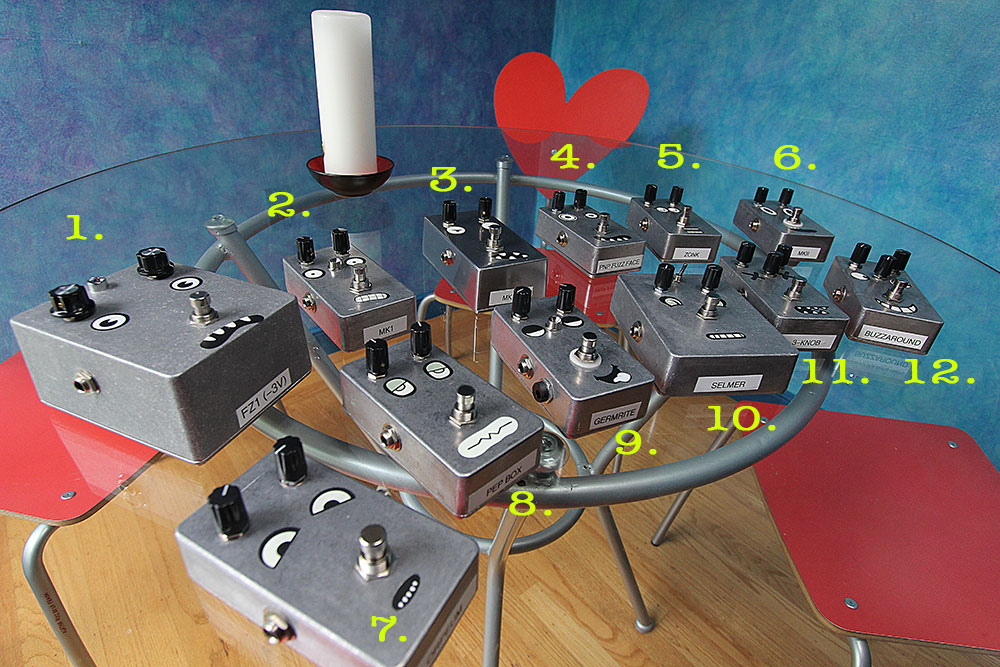
WHO:

  1. Maestro FZ-1 Fuzz Tone
  2. Sola Tone Bender Mk 1
  3. Hornby-Skewes Zonk Machine
  4. Sola Tone Bender “Mk 1.5” (similar to Vox Tone Benders)
  5. Dallas-Arbiter Fuzz Face
  6. WEM Pep Box Rush
  7. Sola Tone Bender Mk II (same as Marshall Supafuzz)
  8. Mosrite Fuzzrite (germanium version)
  9. Orpheum Fuzz (germanium version)
  10. Selmer Buzz Tone
  11. Sola Tone Bender Mk III (same as Park Fuzz Sound, Carlsbro Fuzz)
  12. Baldwin-Burns Buzzaround.

WHEN: Like, now, man!

Categories
Effects

Fuzz Detective: The Plot Thickens!

Man, I’m glad I announced my intentions about this project! Thanks to your links and suggestions, the “Fuzz Detective” project has grown vastly more ambitious. I need a few more days to make my test recordings are assemble the results, but I believe this will be the most complete and “scientific” audio comparison of 1960s fuzz circuits yet attempted. I’m posting this update to share my current plans β€” and solicit last-minute suggestions for improving them. β€”Joe

Wanker's Dozen: twelve Germanium fuzz pedals compete on a level playing field.
Wanker’s dozen: twelve germanium fuzz pedals will finally compete on a level playing field.

I’ve been a busy little solder monkey! Dig my new pedals:

1. Maestro Fuzz Tone FZ-1 clone
2. Sola Tone Bender “Mk I” clone
3. Sola Tone Bender “Mk 1.5” clone (near-twins: Vox Distortion Booster, Italian Vox Tone Benders)
4. Dallas-Arbiter Fuzz Face clone (very similar to Tone Bender Mk 1.5)
5. Hornby-Skewes Zonk Machine clone (near-twin: Tone Bender Mk 1)
6. Sola Tone Bender “Mk II” clone (near-twin: Marshall Supafuzz)
7. Orpheum Fuzz clone
8. WEM Pep Box Rush clone
9. Mosrite Fuzzrite clone (germanium version)
10. Selmer Buzz-Tone clone
11. Sola Tone Bender Mk III (“3-knob”) clone
12. Baldwin-Burns Buzzaround clone

About the Fuzz Detective project:

I’m attempting to create a comprehensive comparative sound library of germanium-transistor fuzz pedal circuits.

There’s no shortage of audio clips and demo videos featuring the great stompboxes of the ’60s and their modern clones. Yet it’s difficult to make qualitative comparisons between circuits because there are so many other variables at play. Who performed the examples? Using what gear? Were the examples recorded in a pro studio or on a mobile phone? Are the pedals ’60s originals or modern clones? What’s the condition of the transistors? And so on.

This isn’t about, say, deciding who makes the best Fuzz Face clone. The focus is the circuits themselves. The Fuzz Detective project aims to “level the playing field” by removing as many variables as possible.

Categories
DIY Effects

Next Week on Fuzz Detective!

UPDATE: Based on cool info supplied by YOU, dear readers, I’m expanding the scope of this piece. I’m furiously wiring up clones of some very rare models, and I can promise many cool and interesting surprises. Thanks, guys! :beer:

Okay, now that we’ve all gotten that silly “reading” stuff out of our systems with Book Week, it’s time to get back to the real focus of this blog: nasty, filthy fuzz pedals.

Last time we were on the subject, we looked at the original version of Dallas-Arbiter Fuzz Face, and included Mitchell “super-freq” Hudson’s beautiful DIY instructions.

Those posts generated many interesting comments β€” plus some misinformation on my part. For example, I said that the original Fuzz Face circuit is a close cousin to the Tone Bender Mk I, which would mean, for example, that known Mk 1 user Mick Ronson was essentially using a Fuzz Face between his Les Paul and his Marshall. But subsequent listening and reading makes me believe I was wrong. So I figured it was time to play fuzz detective and sort the facts from the other stuff.

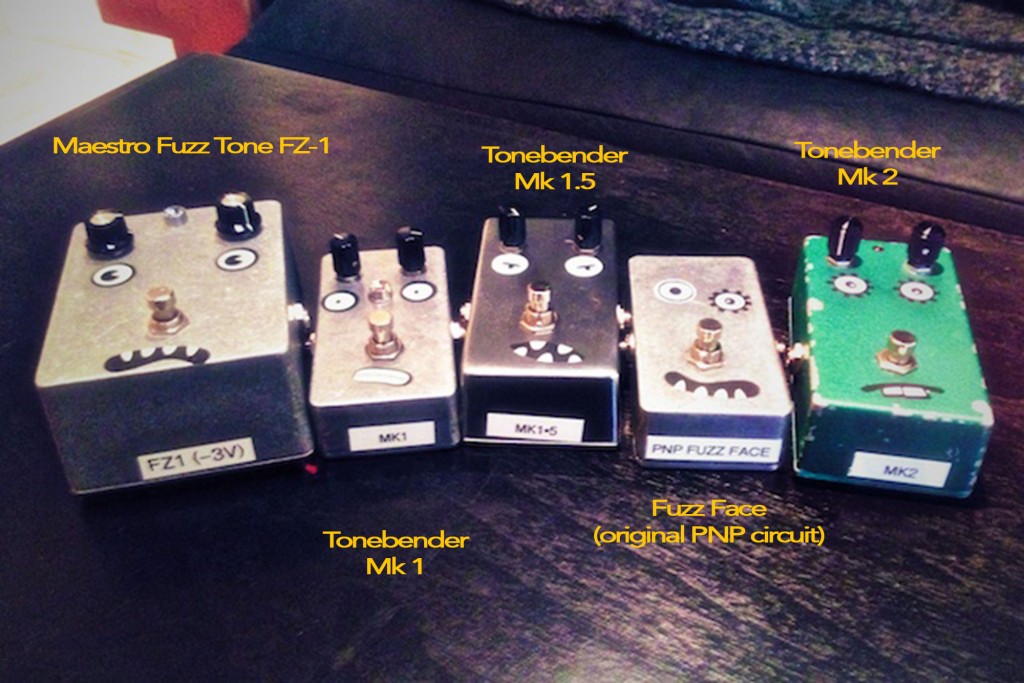
First, I made clones of all the early commercial fuzzes. I’ll be posting a compare-and-contrast video in the coming days. (The audio forensics will be quite incriminating.) Here’s the lineup:

The usual suspects. (Incriminating audio/video evidence to be posted soon!)

I’ve also re-read the experts, and man, even my most trusted sources contradict each other right and left, especially when it comes to those darn Tone Benders. While I have absolutely no inside dope on what actually transpired, I think David from D*A*M Stompboxes offers the most convincing Tone Bender chronology, which you can read here.

Anyway, here’s my best guess about how the early fuzz years unfolded:

Categories
Acoustic Amps DIY Effects guitar

Tonefiend Book Week 2013
Wednesday: Repair and DIY

Monday: Theory and Technique
Tuesday: Gear
Wednesday: Repairs and DIY
Thursday: Biography
Friday: Fiction

Tonefiend Book Week is simple: I discuss a few titles I’ve found particularly enlightening, useful, or entertaining, and then you jump in and do the same.Β I’ve organized the days of this week by subject matter. Today’s topics are repair and DIY.

I'm indispensable.
I’m indispensable.

Sorry in advance if my faves in this category are a bit predictable!

For any repair topic, I turn to the redoubtable Dan Erlewine. Dan knows his stuff like no one else, plus he’s a terrific writer, with a rare talent for explanation and a charming sense of humor.

Dan has serviced the instruments of countless great players. (I’d insert a list, but it might wear out my comma key.) Better yet, he makes comprehensive notes and measurements. You learn much about, say, Albert King, just by studying Dan’s numbers.

Now, I’m the furthest thing from a guitar tech. (Just ask San Francisco’s brilliant Gary Brawer, who regularly rescues my guitars from clumsy abuse and ill-considered DIY attempts.) But for players who simply need help with basic setup, maintenance, and modification tasks, Erlewine’s books β€” The Guitar Player Repair Guide and How to Make Your Electric Guitar Play Great β€” are godsends. Get ’em both. You won’t be sorry. (The digital versions live on my iPad for workbench reference.)

"Me too!"
I’m indispensable too!

I never had the pleasure of editing Dan’s columns when I worked at Guitar Player β€” Jas Obrecht jealously guarded that privilege. But the entire staff would laugh itself silly over Dan’s April Fools columns, like the one where he explained how to install a Floyd Rose tremolo on a pre-War Martin. (If I recall correctly, the process involved filling the body with cement.) Another year, he suggested using kitchen objects as lutherie tools. The photos included a kitchen table used as a clamp for a glue job on some ΓΌber-valuable axe. (Touch of genius: The pic showed the poor guitar being crushed by a weighty trestle table, where Dan’s kids sat enjoying large bowls of breakfast cereal.) That one prompted a very famous guitar maker to write a shrill letter to the editor. (“It’s highly irresponsible for Mr. Erlewine to recommend using a heavy kitchen table as a clamp. Proper clamps don’t even cost that much!”) The luthier followed this with a frantic phone call, explaining that someone had alerted him to the joke, and begging us not to run the letter. We didn’t. (Dagnabbit!)